Cordless vs 12V Car Tire Inflators: CFM Flow Rates, Duty Cycle Heat Dissipation, and Emergency Roadside Top-Offs
Maintaining correct pneumatic tire pressure is vital for fuel efficiency, tread longevity, and highway blowout prevention. This comprehensive engineering evaluation compares modern handheld cordless lithium-ion tire inflators against traditional 12V DC plug-in air compressors, analyzing piston cylinder displacement CFM, adiabatic thermal heating, continuous duty cycles, digital pressure transducer accuracy, and emergency roadside speed.
1. The Urgent Roadside Reality: Why Tire Inflation Performance Matters
Under-inflated automotive tires represent one of the leading causes of catastrophic highway tire blowouts in North America. According to the National Highway Traffic Safety Administration (NHTSA), driving on tires under-inflated by just 25% increases structural tire carcass flexing, causing friction-induced internal sidewall heat accumulation that can reach temperatures exceeding 200°F (93°C) at 70 MPH, culminating in rapid tread delamination and sudden blowout.
When stranded on a dark, narrow highway shoulder with heavy semi-trucks thundering past just feet away, the speed and reliability of your emergency portable air compressor is a matter of life and death. The difference between an inflator that tops off a soft tire from 28 PSI to 35 PSI in 90 seconds versus an underpowered unit that takes 8 minutes (while overheating and blowing a dashboard fuse) determines how quickly you can safely merge back into traffic.
2. Power Delivery Architectures: Cordless Lithium Battery vs. 12V DC Auxiliary Socket
The fundamental engineering difference between portable inflators lies in how electrical energy is converted into pneumatic air pressure:
- Handheld Cordless Lithium-Ion Inflators: Powered by internal high-discharge 3S or 4S lithium-ion battery packs (typically providing 11.1V to 16.8V nominal voltage and 2,500mAh to 7,500mAh capacity). Cordless inflators deliver complete freedom of movement: there are zero tangled power cords to unravel, zero dirty cables dragging through roadside mud or slush, and zero need to turn on your vehicle’s engine. You simply walk to each tire, thread the chuck onto the valve stem, press start, and walk away. However, battery runtime is finite; inflating 4 large truck or SUV tires from completely flat to 40 PSI can deplete a cordless battery pack before the final tire is filled.
- 12V DC Plug-In Air Compressors (The Endless Power Standard): Plugs directly into your car’s 12V auxiliary cigarette lighter socket. As long as your vehicle engine is idling (providing continuous 13.8V to 14.4V alternator output), a 12V compressor has unlimited power and will never leave you stranded with a dead battery. However, they are tethered by a 10-foot to 12-foot electrical power cord that must be routed through car doors and around hot exhaust pipes to reach all four corners of the vehicle.
- Dual-Power Hybrid Inflators (The Ideal Solution): Next-generation portable inflators combine both systems in a single chassis: an internal lithium-ion battery for rapid cordless top-offs, paired with an emergency 12V cigarette lighter backup cable that plugs in if the internal battery is ever flat.

Figure 3: Technical engineering comparison matrix analyzing air flow rate (CFM), inflation times, continuous duty cycles, and power limitations between cordless and 12V plug-in compressors.
3. Piston Cylinder Displacement & Air Flow Rates (CFM vs. LPM)
Tire inflator performance is dictated by cylinder bore volume, stroke length, and motor torque:
- Cubic Feet per Minute (CFM) and Liters per Minute (LPM): Cheap budget inflators utilize tiny 16mm or 19mm plastic piston cylinders outputting an anemic 12 to 18 Liters per Minute (LPM) (approx. 0.4 to 0.6 CFM). They struggle mightily against backpressure as tire pressure climbs past 30 PSI. High-performance portable inflators incorporate solid 22mm to 28mm cold-forged metal cylinders powered by high-torque permanent magnet DC motors, delivering 35 to 45 LPM (approx. 1.2 to 1.6 CFM).
- The 15-Amp Vehicle Fuse Bottleneck: The standard 12V cigarette lighter socket in passenger vehicles is protected by a 15-amp fuse (limiting electrical power to 12 Volts multiplied by 15 Amps = 180 Watts maximum). High-output dual-cylinder off-road compressors (such as Viair 400P or ARB) draw 25 to 30 amps and must be clamped directly onto the car battery posts with heavy-duty alligator clips rather than plugged into the dashboard socket!
4. Thermodynamics: Adiabatic Compression & Duty Cycle Limits
Compressing ambient air generates immense thermal energy governed by the Ideal Gas Law:
- Adiabatic Piston Heating: Rapidly forcing atmospheric air into a confined tire volume causes rapid adiabatic temperature spikes. The metal cylinder head of a portable compressor can easily exceed 180°F (82°C) within 10 minutes of continuous operation. The brass quick-connect chuck on the valve stem will become blistering hot to the touch!
- Duty Cycle Classification: Most compact consumer inflators have a 20% to 30% duty cycle rating (typically 10 to 15 minutes of continuous running, followed by a mandatory 20-minute cooling interval). Operating an under-designed compressor past its duty cycle limit melts the internal Teflon piston ring seal, causing permanent loss of compression.
- Internal Thermal Protection Cutoff: Quality commercial units integrate a bimetallic thermal sensor clamped directly to the aluminum cylinder head. If the core temperature exceeds safe operational limits (typically 175°F / 80°C), the micro-controller automatically cuts power to protect the motor from thermal seizure.
5. Digital Pressure Transducer Precision & Auto-Shutoff Calibration
Analog dial gauges bouncing wildly while the motor vibrates provide terrible measurement accuracy:
- Silicon Piezoresistive Digital Pressure Transducers: Advanced digital inflators integrate solid-state piezoresistive pressure sensors accurate to within ±0.5 PSI. High-contrast backlit LCD screens display real-time pressure in PSI, BAR, KPA, or kg/cm².
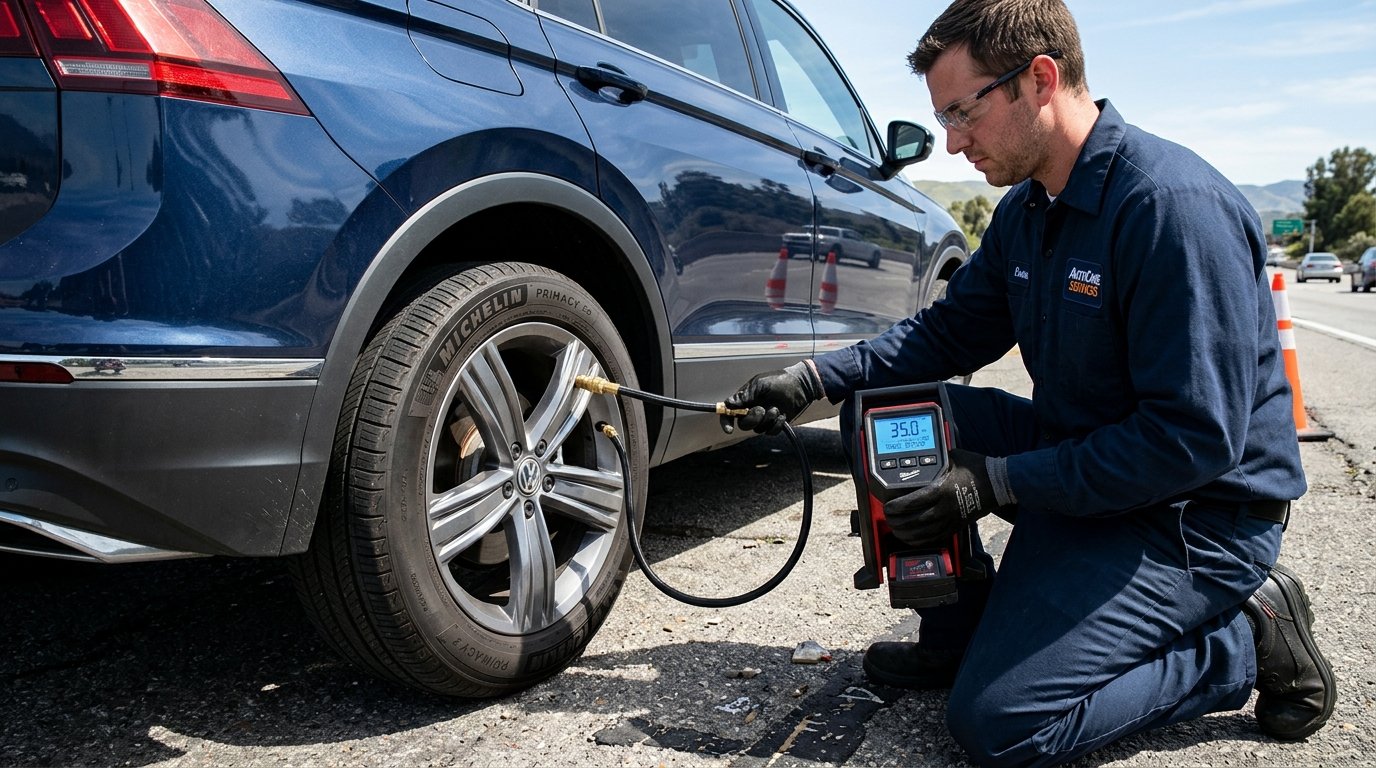
- Microprocessor Auto-Stop Algorithm: You pre-set your target cold tire pressure (e.g. 35.0 PSI) using tactile +/- buttons. As the compressor approaches the target, the microprocessor compensates for air pulse backpressure, automatically shutting off the motor the exact millisecond the target pressure is stabilized. This completely eliminates the tedious cycle of stopping, unhooking, testing with an external gauge, and reconnecting.
- Screw-On Brass Chuck vs. Thumb-Lock Lever: Cheap plastic thumb-lock chucks frequently leak air around the Schrader valve threads. Heavy threaded solid brass chucks or premium brass quick-connect couplers create an airtight, zero-leak seal that withstands high-pressure vibration without popping off.
6. Winter Electrolyte Viscosity & Glovebox Cold Storage
Sub-zero winter blizzards represent the exact scenario where tire pressures drop drastically (losing 1 to 2 PSI for every 10°F drop in ambient temperature) and where portable inflators are needed most:
- Lithium Polymer Electrolyte Freezing: When stored in a freezing trunk at 0°F (-18°C) for several days, the liquid electrolyte inside lithium-ion battery cells becomes sluggish and highly viscous. Internal battery resistance triples, severely restricting peak discharge amperage. A cordless inflator that easily pumps 4 tires in summer may struggle to fill a single tire in freezing winter conditions before displaying a low-battery cutoff alert.
- Insulated Thermal Pouch Storage: In extreme cold climates, store your cordless inflator in a padded thermal insulating case inside the passenger cabin or bring it indoors overnight before winter road trips. Alternatively, ensure your inflator includes an emergency 12V cigarette lighter backup cable that draws direct high-amperage current from the vehicle’s running alternator.
7. Universal Valve Stem Adapters: Presta, Schrader & Sporting Gear
A high-quality portable air compressor serves double duty for household and recreation:
- Brass Schrader to Presta Adapters: In addition to standard automotive Schrader valve stems, quality kits include threaded brass Presta adapters for high-pressure road bicycles, ball needles for footballs and basketballs, and plastic cone nozzles for inflatable kayaks and camping air mattresses.
- High-Pressure Piston vs. High-Volume Blowers: High-pressure piston compressors excel at forcing air into small volumes up to 150 PSI, but move relatively low cubic volume. Dual-mode compressors include a secondary low-pressure, high-volume rotary blower port designed specifically for rapid inflation and deflation of large stand-up paddleboards and camping rafts in under 3 minutes.
8. Pressure Gauge Calibration Verification and Drift Testing
Ensuring long-term measurement reliability of your portable inflator’s digital pressure transducer:
- Cross-Checking with a Master Bourdon Tube Gauge: Electronic pressure sensors can experience calibration drift over years of vibration and extreme temperature swings. Twice a year, compare your inflator’s digital readout against an oil-filled, ANSI Grade B calibrated mechanical Bourdon tube test gauge. If variance exceeds 1.5 PSI, recalibrate the transducer offset via the unit’s calibration button sequence.
- Thread Care and O-Ring Lubrication: Apply a microscopic drop of pure silicone dielectric lubricant to the rubber O-ring inside the brass valve chuck every six months to prevent rubber dry rot and maintain a hermetic seal against valve stem threads.
9. Frequently Asked Questions (FAQ)
Can a cordless tire inflator hold its battery charge inside a hot or freezing car?
Quality lithium-ion battery inflators incorporate advanced Battery Management Systems (BMS) with very low self-discharge rates (approximately 2% to 3% per month). However, extreme summer heat (140°F inside a parked car) or sub-zero winter temperatures degrade lithium capacity over time. We recommend checking and recharging your cordless inflator once every 3 to 4 months to guarantee it is 100% ready for roadside emergencies.
Should I set my tire inflator higher than the pressure listed on the tire sidewall?
Never inflate to the pressure stamped on the tire sidewall! The sidewall number represents the maximum permissible structural pressure at maximum load capacity. Always inflate to the vehicle manufacturer’s recommended cold tire pressure printed on the white safety placard located on the driver-side door jamb (typically between 32 PSI and 36 PSI for passenger sedans and crossover SUVs).
Top 5 Best Portable Tire Inflators Tested & Ranked
Review our comprehensive laboratory bench testing evaluating inflation fill speeds from 28 to 35 PSI, continuous duty cycle thermal endurance, digital gauge transducer precision, and battery longevity.
DriveGear Lab pneumatic testing adheres to Tire and Rim Association (TRA) engineering standards and NIST Handbook 44 pressure transducer calibration guidelines.