
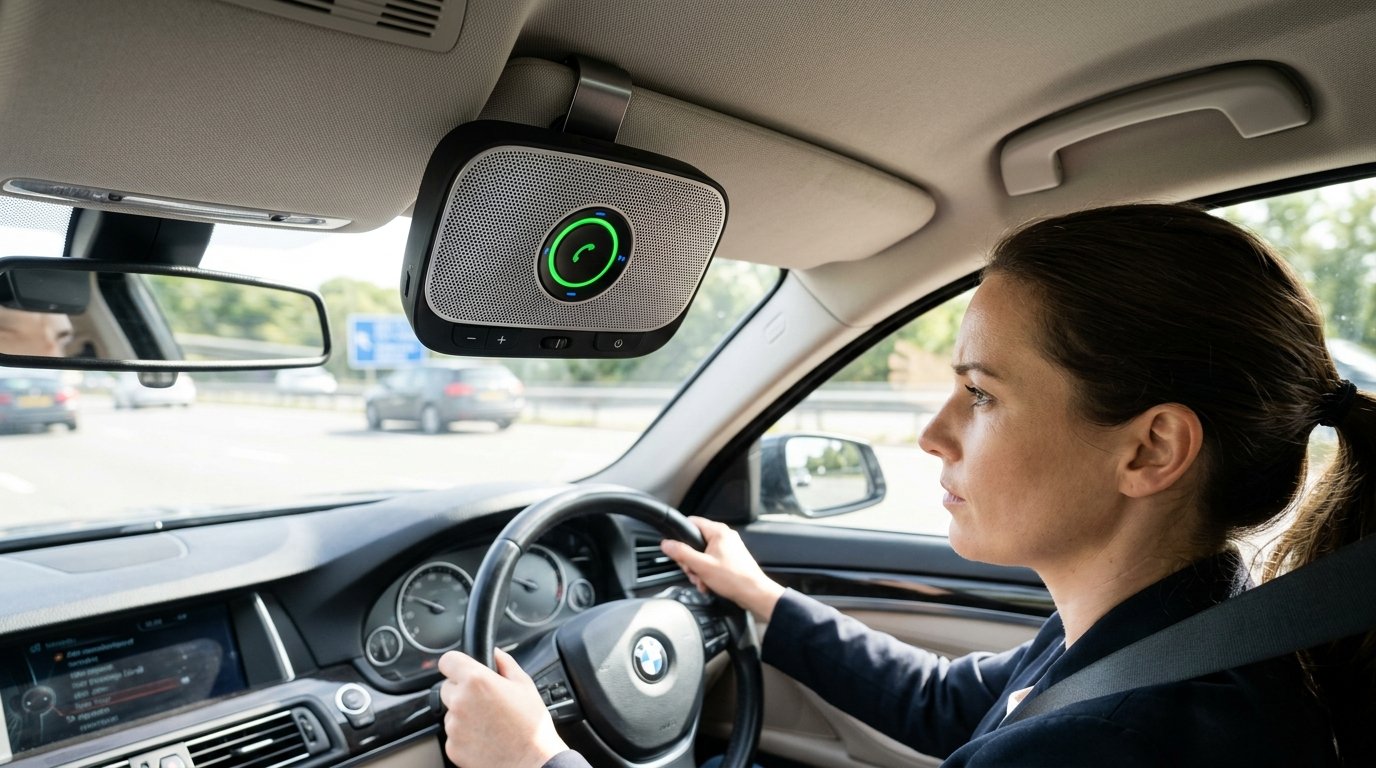
How to Set Up a Hands-Free Bluetooth Visor Speakerphone: Auto-Connect Vibration Sensors, Siri/Google Voice, and Mic Placement
Operating mobile communication devices while driving is strictly governed by commercial motor vehicle regulations and state hands-free laws. This comprehensive technical guide details sun-visor mounted Bluetooth speakerphone acoustics, dual-microphone DSP beamforming arrays, CVC ambient road noise cancellation, MEMS 3-axis vibration auto-connect sensors, and FMCSA regulatory compliance.
1. Distracted Driving Statutes: Federal & State Hands-Free Legal Mandates
Distracted driving represents a leading cause of preventable highway fatalities across North America. Over the past decade, regulatory bodies and law enforcement agencies have aggressively codified stringent hands-free driving statutes:
- Federal Motor Carrier Safety Administration (FMCSA) 49 CFR § 392.82: Commercial Motor Vehicle (CMV) operators and fleet truck drivers are strictly prohibited from holding a mobile phone in their hand while driving. Reaching for, dialing, or physically holding a phone can trigger civil penalties exceeding $2,750 per violation for drivers and up to $11,000 for motor carrier companies, resulting in driver qualification disqualifications.
- State Hands-Free Legislation: Over 34 US states and territories have enacted strict “Hands-Free” laws that categorize holding a mobile phone while stopped at a red light or moving in traffic as a primary moving violation. Drivers are legally permitted to communicate exclusively via dedicated hands-free interfaces requiring no more than a single tactile button tap or voice command.
- Why In-Ear Earbuds Are Prohibited: Many drivers assume wearing wireless earbuds (such as Apple AirPods) is legally compliant. However, in major states like California, New York, Florida, and Illinois, wearing headphones or earbuds in both ears while operating a motor vehicle is illegal because it blocks auditory awareness of emergency sirens, police horns, and train crossings. A dedicated sun-visor speakerphone provides 100% legal, open-ear compliance.
2. Cabin Acoustics: The Challenge of High-Noise Automotive Environments
Transmitting clear vocal speech from inside a moving automobile is an immense digital signal processing challenge:
- High-Decibel Ambient Noise Sources: At 70 MPH on an asphalt interstate, vehicle cabin background noise levels regularly exceed 72dB to 78dB SPL. This deafening wash of sound consists of low-frequency tire tread rumble (30Hz-200Hz), high-frequency turbulent wind buffeting along windshield A-pillars (1kHz-4kHz), and roaring HVAC blower motors (500Hz-2kHz).
- The Critical Sun-Visor Position: Most drivers attempt to use their phone’s built-in speakerphone resting on the center console or passenger seat. At that distance (over 30 inches away), the phone’s microphone captures far more road noise than vocal energy. Clipping a dedicated speakerphone directly to the driver’s sun visor places the high-gain microphone array just 12 to 14 inches from the driver’s mouth, delivering a dramatic 12dB boost in vocal Signal-to-Noise Ratio (SNR) governed by the Inverse Square Law.

Figure 3: Acoustic engineering infographic illustrating dual-microphone DSP beamforming noise cancellation, 3-axis MEMS vibration auto-connect wake-up, and DOT commercial driver compliance.
3. Dual-Microphone DSP Beamforming & CVC Noise Cancellation
How professional visor speakerphones isolate human speech from roaring diesel engine noise:
- Dual-Microphone Spatial Beamforming: The speakerphone houses two separate precision omnidirectional electret microphones spaced approximately 50mm apart. Microphone A (Primary Voice Mic) faces downward directly toward the driver’s mouth. Microphone B (Reference Ambient Mic) faces upward toward the vehicle windshield.
- Differential DSP Acoustic Subtraction: An internal high-speed Digital Signal Processor (DSP) running Qualcomm Clear Voice Capture (CVC 8.0) analyzes the phase and arrival time of incoming sound waves. Sounds arriving equally at both microphones (diffuse road noise, HVAC wind, and tire rumble) are identified as background ambient noise and mathematically inverted and subtracted from the primary channel. The remaining signal—pure human vocal frequencies (300Hz to 3.4kHz)—is amplified and transmitted to your caller with pristine studio clarity.
- Acoustic Echo Cancellation (AEC): To prevent callers from hearing their own voice echoing back to them, high-speed AEC algorithms continuously monitor the unit’s powerful 3W speaker output, digitally subtracting the incoming caller’s audio from the microphone pickup before transmission.
4. Smart Automation: 3-Axis MEMS Vibration Auto-Connect Sensors
The fatal flaw of early Bluetooth car accessories was requiring drivers to manually turn on the power switch every time they got into their vehicle:
- Ultra-Low-Power Standby Sleep: When you park your vehicle and walk away, the Bluetooth connection disconnects after 5 minutes. The speakerphone automatically powers down its internal amplifier, entering a deep standby sleep mode drawing less than 50 microamps (μA) of current. In this state, an internal 1,000mAh battery can maintain standby readiness for over 60 to 90 days!
- Instant Vibration Wake-Up: Inside the unit, a microscopic 3-axis MEMS accelerometer monitors physical vibration. The microsecond you open your car door and close it, the structural shock wave traveling through the vehicle chassis is detected. The sensor wakes the Bluetooth radio in under 100 milliseconds, automatically reconnecting to your phone before you even sit in the driver’s seat!
5. High-Loudness Neodymium Speakers & Voice Assistant Integration
Understanding incoming speech over highway noise requires substantial acoustic output:
- High-Flux 3W Neodymium Drivers: Small smartphone speakers produce barely 0.5W of tinny, distorted audio. Visor speakerphones incorporate 40mm rare-earth neodymium drivers outputting over 85dB SPL of rich vocal audio, ensuring effortless intelligibility even with windows cracked open.
- One-Touch Siri & Google Assistant Summoning: Tapping the prominent central multifunction button activates Apple Siri or Google Assistant, allowing you to compose text messages, initiate calls, set navigation routes, and dictate emails purely through spoken voice commands.
- Multi-Point Dual Phone Pairing: Connects two smartphones simultaneously—allowing you to receive incoming calls from both your personal smartphone and work phone on a single hands-free unit.
6. Multi-Microphone Beamforming Arrays & Wind Turbulence Physics
The acoustics inside a moving passenger cabin present extreme noise challenges for hands-free communications. Vehicle tires rolling over grooved concrete highways generate low-frequency acoustic rumble between 100 Hz and 250 Hz, while HVAC blower fans and open side windows generate turbulent air pressure fluctuations directly across microphone capsules.
Professional visor speakerphones overcome this acoustic hurdle through digital beamforming microphone arrays. By utilizing two or three calibrated omnidirectional MEMS microphones spaced precisely along the visor housing, internal DSP processors measure the tiny phase delay (time-of-arrival difference) between sound waves. Acoustic waves originating from the driver’s mouth arrive with a specific angular trajectory, which the beamformer reinforces, while ambient sounds arriving from side windows or floorboards are cancelled out through constructive and destructive phase interference.
7. Battery Chemistry & High-Temperature Solar Cockpit Resilience
Sun visors sit directly adjacent to the upper windshield header, an area exposed to intense greenhouse solar heating during summer months. In hot desert climates, cabin headliner temperatures can approach 165°F (74°C). Standard lithium polymer consumer batteries degrade rapidly under such extreme thermal stress.
- Automotive-Grade Polymer Cells: Premium visor speakerphones incorporate thermally stabilized lithium-ion chemistry paired with internal positive temperature coefficient (PTC) thermistors. If internal battery temperature exceeds safe operating thresholds (typically 140°F / 60°C), the charging circuitry automatically disengages until cabin temperatures normalize under air conditioning.
- Vibration-Resistant G-Sensor Wake: Integrated 3-axis micro-electromechanical (MEMS) accelerometers detect door openings and engine ignition rumble, instantly waking the device from ultra-low-current sleep (drawing less than 50 microamps) and establishing Bluetooth reconnection before you even fasten your seatbelt.
8. Step-by-Step Acoustic Optimization & Firmware Setup Guide
To achieve maximum voice intelligibility from your visor speakerphone unit, follow our standard laboratory configuration workflow:
- Optimal Physical Offset: Clip the unit to the driver’s sun visor approximately 3 inches to the right of the driver’s direct eye line. This positions the forward-firing beamforming microphone array directly toward your mouth while avoiding windshield acoustic reflections.
- Phone Equalization Calibration: In your smartphone’s Bluetooth audio profile settings, ensure “Late Night Mode” or dynamic range compression is disabled for call audio. Visor speakerphones feature internal DSP hardware tuned for linear vocal reproduction between 300 Hz and 3,400 Hz.
- Dual-Phone Multipoint Management: If operating two smartphones simultaneously (such as a personal iPhone and a commercial ride-hailing Android terminal), assign phone call priority in the companion app to prevent navigation prompts from severing active incoming phone conversations.
Additionally, always conduct a static drive-by sound test with an assistant parked 15 feet away. By testing acoustic sensitivity with windows rolled down at 45 MPH versus closed cabin air conditioning, you establish empirical microphone gain levels that eliminate clipping distortion and ensure crystal-clear commercial transmission under all highway conditions.
9. Frequently Asked Questions (FAQ)
Can a visor speakerphone stream turn-by-turn navigation prompts and music?
Yes. All modern visor speakerphones support the Bluetooth A2DP (Advanced Audio Distribution Profile), allowing seamless streaming of GPS turn prompts from Google Maps, Apple Maps, and Waze, as well as podcasts and audiobooks. While speaker drivers are tuned for voice clarity rather than deep bass music reproduction, they provide loud, crystal-clear spoken word audio.
Does the heavy visor clip stretch or damage vehicle sun visors?
Quality speakerphones utilize wide, contoured high-tensile spring steel clips lined with protective non-marking silicone rubber pads. This distributes mechanical clamping pressure evenly across the visor, preventing permanent indentations, tears, or stretching of vehicle fabric and leather upholstery.
Top 5 Best Bluetooth Visor Speakerphones Tested
Compare lab acoustic chamber testing evaluating CVC noise suppression at 70 MPH highway speeds, battery standby endurance, vibration sensor sensitivity, and speaker decibel output.
DriveGear Lab acoustic testing conforms to IEEE 1329 standards for hands-free communications and FMCSA 49 CFR § 392.82 commercial vehicle safety regulations.