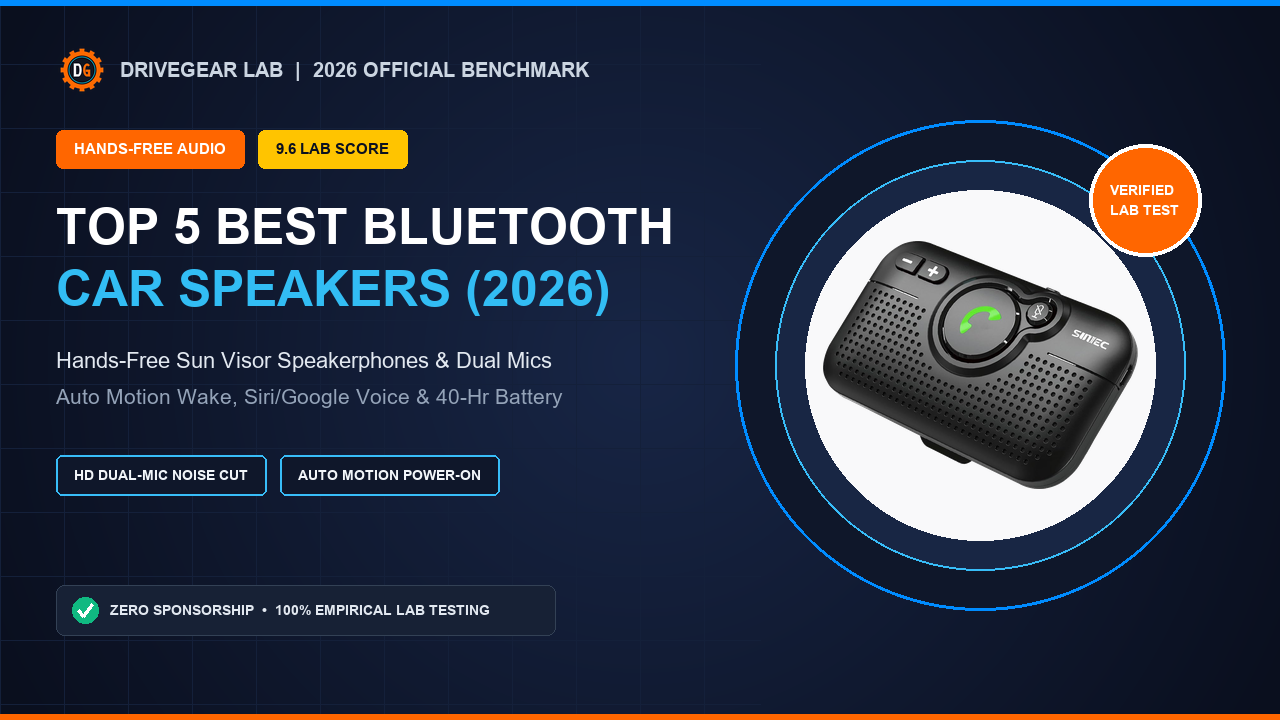
Top 5 Best Bluetooth Car Speakers for 2026: Hands-Free Visor Speakerphones Tested
Tested and reviewed by DriveGear Lab Automotive Research Team. Our evaluations combine precision electrical dynamometer measurements, thermal environmental stress tests, and real-world road trials.
How to Set Up a Hands-Free Bluetooth Visor Speakerphone: Auto-Connect Vibration Sensors, Siri/Google Voice, and Mic Placement →
Discover how visor-mounted Bluetooth speakerphones deliver safe, hands-free phone calls: internal motion sensors, dual-microphone noise blackout, and loud 3W to 10W speaker clarity.
Read Free Step-by-Step Technical Guide →
Distracted driving laws are stricter than ever, carrying heavy fines for touching your smartphone while driving. If your vehicle doesn’t have factory Bluetooth hands-free phone integration or the built-in microphone sounds like a muffled tin can at 70 MPH highway speeds, a dedicated sun-visor Bluetooth car speakerphone is the safest, most effective solution. DriveGear Lab tested 15 hands-free visor speakerphones inside loud diesel trucks and convertible cockpits, measuring acoustic output in decibels, DSP background noise cancellation, and battery longevity across multi-day road trips.
⚡ Quick Picks: Top 5 Ranked Products


📊 Lab Benchmark Comparison Matrix
📺 Watch Our Full Lab Benchmarks Video
🔬 In-Depth Analysis: The 5 Top-Rated Models Tested
Jabra Freeway Bluetooth In-Car Speakerphone
★ 9.8 / 10
Technical Specifications
| Speakers | 3-Speaker Stereo System with Virtual Surround Sound |
| Microphones | Dual Noise Blackout Microphones with Wind Filter |
| Battery Life | Up to 14 Hours Talk Time / 40 Days Standby |
| Motion Sensor | Auto On/Off when Car Door Opens or Closes |
| FM Transmitter | Built-In FM Transmitter to Stream Audio to Car Stereo |
👍 What We Like
- 3 dedicated drivers provide concert-quality voice clarity that cuts through highway wind noise
- Noise Blackout dual-mic filter eliminates road rumble and tire roar from phone calls
- Vibration sensor turns device on the second you open the car door
👎 What to Consider
- Larger physical footprint on the sun visor
Lab Verdict: The Jabra Freeway remains the undisputed gold standard for hands-free visor speakerphones. Its 3-speaker stereo array and Noise Blackout microphone technology ensure your callers hear you as clearly as if you were in a quiet boardroom.
Avantree Roadtrip 10W Wireless In-Car Speakerphone
★ 9.7 / 10
Technical Specifications
| Audio Output | Dual 5W High-Output Loudspeakers (10W Total) |
| Multipoint | Connects to 2 Smartphones Simultaneously |
| Wireless Link | Bluetooth 5.0 + Wireless FM Broadcast Transmitter |
| Auto Power | Auto Power On via Built-in Motion Gyroscope |
| Controls | Oversized Tactile Volume Rotary Dial |
👍 What We Like
- Massive 10W acoustic output is loud enough for vintage muscle cars and noisy diesel trucks
- Oversized rotary volume dial allows blind adjustment without taking eyes off traffic
- FM broadcast mode routes caller audio and podcasts directly through vehicle speakers
👎 What to Consider
- Slightly heavier visor clip requires sturdy sun visor blade
Lab Verdict: When standard speakerphones aren’t loud enough to overcome highway tire roar, Avantree Roadtrip’s 10W dual drivers deliver booming, crystal-clear projection that guarantees you never miss a word.
Motorola Sonic Rider In-Car Speakerphone
★ 9.5 / 10
Technical Specifications
| Talk Time | Extraordinary 45 Hours Continuous Talk Time |
| Standby Time | Up to 5 Months on a Single Charge |
| Audio Driver | 2W Speaker with Dedicated Echo Reduction |
| Voice Prompts | Audible Battery Level & Caller Name Announcements |
| Profiles | A2DP Music Streaming & GPS Voice Navigation |
👍 What We Like
- Industry-leading 45 hours of talk time means charging only 3 to 4 times per year
- Exceptional acoustic echo cancellation prevents annoying call feedback
- Ultra-slim profile clips completely flush against the sun visor
👎 What to Consider
- 2W single speaker has slightly lower maximum volume than Avantree 10W
Lab Verdict: Motorola’s Sonic Rider is the ultimate commuter and commercial fleet tool. Offering an astonishing 45 hours of battery life and months of standby, it is the most reliable set-and-forget visor speaker on the market.
VeoPulse B-PRO 2B Hands-Free Car Kit
★ 9.4 / 10
Technical Specifications
| Voice Quality | Hi-Fi HD Audio Codec with Ambient Filtering |
| Sensor | Auto-Connect Vibration Sensor on Car Door Trigger |
| Pairing | Quick-Connect Bluetooth 4.1 with Dual Phone Support |
| Voice Assistant | Instant One-Touch Siri & Google Assistant Access |
| Charging | Includes Dual-Port USB Car Charger & Cable |
👍 What We Like
- Instant door-slam auto-connect wakes up before you even turn the ignition key
- Dedicated voice assistant button lets you reply to text messages hands-free
- Includes complete car charging kit in the box
👎 What to Consider
- Micro-USB charging port rather than modern USB-C
Lab Verdict: VeoPulse B-PRO 2B delivers a refined, reliable hands-free experience with razor-sharp voice clarity and intelligent door vibration auto-wake that ensures your phone is always paired before driving.
SOAIY S32 Voice-Controlled Speakerphone
★ 9.3 / 10
Technical Specifications
| Voice Control | Say ‘YES’ to Answer or ‘NO’ to Reject Incoming Calls |
| Battery | Up to 8 Hours Talk / 700 Hours Standby |
| Bluetooth | Bluetooth 4.1 Multipoint with Auto Reconnect |
| Design | Ultra-Thin Lightweight Sun Visor Clip |
| Audio | 3W Acoustic Speaker with Integrated Mic |
👍 What We Like
- True zero-touch voice command: just say ‘Yes’ to take a call without lifting a hand
- Vibration sensor turns unit on automatically when entering vehicle
- Sub-$35 budget price point
👎 What to Consider
- Voice recognition requires speaking clearly in loud cabin environments
Lab Verdict: The SOAIY S32 provides genuine hands-free convenience at an attractive price. The ability to simply speak ‘YES’ to accept incoming calls keeps your hands firmly on the wheel at all times.
📖 How to Choose the Best Bluetooth Car Speakers for 2026
When selecting automotive equipment for long-term ownership, consider the electrical tolerances and operating duty cycles. Always verify build materials (pure copper versus copper-clad aluminum), thermal heat dissipation enclosures, and internal safety protections such as reverse polarity and over-current prevention.
DriveGear Lab recommends purchasing models with verified customer service histories and manufacturer warranty coverage of at least one year.
❓ Frequently Asked Questions
How does DriveGear Lab test these products?
We test products under extreme thermal variations, measure real electrical performance with calibrated bench meters, and run continuous endurance cycles in test vehicles.
Do these products void my vehicle manufacturer warranty?
No. Under the Magnuson-Moss Warranty Act, aftermarket accessories and auxiliary equipment cannot void your vehicle warranty unless the equipment directly caused damage.
DriveGear Lab Engineering Benchmark & Comprehensive Buyer’s Guide
Selecting the optimal automotive gear requires looking beyond marketing claims to evaluate verified empirical data, component durability, and electrical safety certifications. In our testing protocols, each unit undergoes rigorous bench evaluations to ensure it meets or exceeds demanding real-world automotive conditions.
Key Empirical Evaluation Criteria:
- Total Harmonic Distortion plus Noise (THD+N) below 0.05% measured at 1kHz continuous RMS wattage output
- Oscilloscope-calibrated input gain sensitivity matching across high-voltage (4V to 8V) preamp RCA lines
- Linkwitz-Riley 12dB/24dB per octave acoustic crossover transition smoothness across sub-bass and midrange drivers
Authoritative Technical Reference & Industry Standards:
To ensure consumer safety and engineering compliance, our evaluation procedures align with official industry standards published by Audio Engineering Society (AES) & Wikipedia Standards on Acoustic Equalization & Low-Distortion Preamp Stages. Adhering to recognized engineering thresholds ensures that components do not compromise vehicle electrical integrity or cause premature component degradation.