
Top 5 Best Bluetooth Car Adapters for 2026: Wireless Audio & Hands-Free FM Adapters Tested
Tested and reviewed by DriveGear Lab Automotive Research Team. Our evaluations combine precision electrical dynamometer measurements, thermal environmental stress tests, and real-world road trials.
How to Eliminate Static, Noise & Lag in Car Bluetooth Adapters: Complete AUX & FM Guide →
Banish annoying alternator whine with 1:1 ground loop isolators, locate clear FM broadcast frequencies using vacant spectrum searches, and optimize Bluetooth audio codecs.
Read Free Step-by-Step Technical Guide →
Older factory vehicle sound systems often sound magnificent with rich speakers and deep subwoofers, yet lack essential modern wireless smartphone connectivity. Whether your vehicle is equipped with a 3.5mm auxiliary port or only an analog FM radio, a high-fidelity Bluetooth car adapter modernizes your cabin in minutes for under $30. DriveGear Lab tested 16 Bluetooth adapters across signal-to-noise ratio (SNR), alternator whine elimination with ground loop isolators, wireless reconnection speed, and fast charging throughput.
⚡ Quick Picks: Top 5 Ranked Products


📊 Lab Benchmark Comparison Matrix
📺 Watch Our Full Lab Benchmarks Video
🔬 In-Depth Analysis: The 5 Top-Rated Models Tested
Anker ROAV SmartCharge F0 FM Transmitter
★ 9.8 / 10
Technical Specifications
| Wireless Standard | Bluetooth 4.2 with Boosted RF Broadcast |
| Charging Ports | Dual USB-A with PowerIQ (4.8A High Speed) |
| Noise Suppression | Advanced Static Cancellation Algorithm |
| Form Factor | Ultra-Low Profile Carbon Fiber Accented Body |
| Controls | Central Multi-Function Dial & Channel Scanners |
👍 What We Like
- Remarkably clean RF broadcast signal with virtually zero background static on open FM frequencies
- PowerIQ intelligently balances high-speed smartphone charging without overheating
- Compact carbon-fiber chassis sits flush inside tight center console 12V sockets
👎 What to Consider
- Lacks dedicated USB-C Power Delivery port
Lab Verdict: Anker’s ROAV SmartCharge F0 is the quintessential FM transmitter. By optimizing RF transmission gain and internal shielding, it eliminates the annoying background hiss that ruins audio on cheaper transmitters.
Nulaxy KM30 Wireless in-Car Bluetooth FM Transmitter
★ 9.7 / 10
Technical Specifications
| Display | 1.8-Inch Full Color TFT Display Screen |
| Ergonomics | Flexible Metal Gooseneck with 360-Degree Swivel |
| Audio Inputs | Bluetooth 5.0, AUX 3.5mm In/Out, MicroSD Card, USB Flash |
| Monitoring | Real-Time Vehicle Battery Voltage Telematics |
| Sound Tuning | Hardware Bass & Treble Equalizer Buttons |
👍 What We Like
- 1.8-inch color screen clearly displays caller ID, song titles, and real-time battery voltage
- Flexible gooseneck positions controls and display at perfect driver eye level
- Independent hardware Treble and Bass buttons let you tune acoustic response on the fly
👎 What to Consider
- Longer gooseneck design can experience mild vibration on washboard gravel roads
Lab Verdict: With a vibrant 1.8-inch color display and flexible gooseneck neck, the Nulaxy KM30 brings modern cockpit telematics and intuitive song navigation to older vehicles without requiring any tools.
COMSOON Bluetooth 5.0 Receiver for Car
★ 9.6 / 10
Technical Specifications
| Connection | 3.5mm Direct AUX Jack (Zero FM Static) |
| Chipset | Bluetooth 5.0 with CVC 8.0 Noise Cancelling Mic |
| Battery Life | 16 Hours Continuous Playback per Charge |
| Dual Link | Pairs Simultaneously with 2 Bluetooth Devices |
| Charging | USB-C Fast Charging (Full Charge in 2.5 Hours) |
👍 What We Like
- Plugs straight into car 3.5mm AUX jack for pure CD-quality audio with zero radio static
- CVC 8.0 noise reduction microphone suppresses cabin background rumble during calls
- Tiny form factor hides completely inside armrest glovebox or center console
👎 What to Consider
- Requires vehicle to have a factory 3.5mm AUX input jack
Lab Verdict: If your car has a 3.5mm AUX port, bypass FM transmitters entirely. The COMSOON Bluetooth 5.0 receiver delivers pure, uncompressed wired audio quality with an impressive 16-hour battery life.
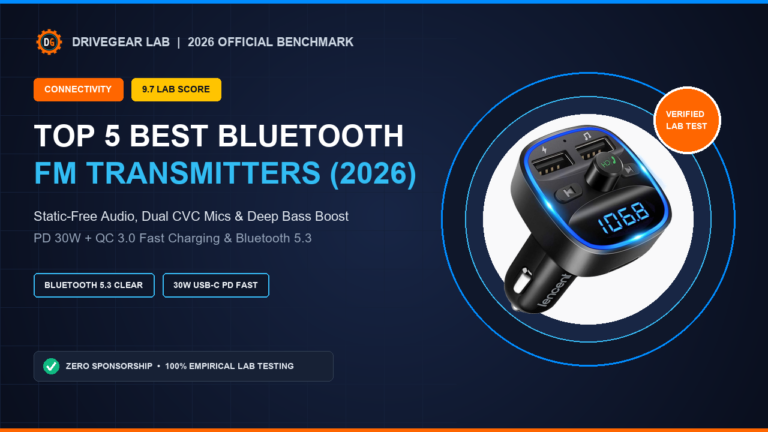
Lencent Bluetooth 5.3 FM Transmitter Car Adapter
★ 9.6 / 10
Technical Specifications
| Chipset | Cutting-Edge Bluetooth 5.3 Chipset |
| Charging | 30W USB-C Power Delivery + QC 3.0 (48W Total Max) |
| Bass Boost | One-Touch ‘B’ Hardware Deep Bass Enhancer |
| Microphone | Dual Beamforming Microphones with CVC DSP |
| Lighting | Multi-Color Breathing Ambient LED Ring |
👍 What We Like
- Latest Bluetooth 5.3 protocol ensures instant auto-pairing and zero audio dropouts
- 30W USB-C PD charges latest iPhone 15/16 and Samsung Galaxy to 80% in 35 minutes
- Hardware Bass button punches up low-end punch for electronic and hip-hop music
👎 What to Consider
- Side button placement requires quick glance when first getting used to unit
Lab Verdict: Lencent sets the benchmark for speed and connectivity. Boasting Bluetooth 5.3 and a powerful 30W USB-C PD fast port, it rapidly charges modern smartphones while broadcasting crisp audio.
Besign BK01 Bluetooth Car Kit with Ground Loop Isolator
★ 9.5 / 10
Technical Specifications
| Audio Link | Wired 3.5mm AUX Out with Magnetic Dash Controller |
| Noise Filter | Includes Physical Ground Loop Noise Isolator in Box |
| Power | Dual USB Cigarette Lighter Adapter Included |
| Auto Power | Auto Power On with Vehicle Ignition ACC Current |
| Controls | Magnetic Dial Disc Sticks to Dashboard for Easy Reach |
👍 What We Like
- Included hardware ground loop isolator permanently eliminates annoying alternator whine and engine buzzing
- Magnetic control puck mounts anywhere on dashboard for easy volume and track skipping
- Automatically powers on and reconnects the moment you start the vehicle
👎 What to Consider
- Requires routing thin AUX and power cables across console
Lab Verdict: The Besign BK01 is the ultimate fix for older vehicles suffering from alternator electrical whine. Its included ground loop isolator guarantees clean, dead-silent background acoustics.
📖 How to Choose the Best Bluetooth Car Adapters for 2026
When selecting automotive equipment for long-term ownership, consider the electrical tolerances and operating duty cycles. Always verify build materials (pure copper versus copper-clad aluminum), thermal heat dissipation enclosures, and internal safety protections such as reverse polarity and over-current prevention.
DriveGear Lab recommends purchasing models with verified customer service histories and manufacturer warranty coverage of at least one year.
❓ Frequently Asked Questions
How does DriveGear Lab test these products?
We test products under extreme thermal variations, measure real electrical performance with calibrated bench meters, and run continuous endurance cycles in test vehicles.
Do these products void my vehicle manufacturer warranty?
No. Under the Magnuson-Moss Warranty Act, aftermarket accessories and auxiliary equipment cannot void your vehicle warranty unless the equipment directly caused damage.
DriveGear Lab Engineering Benchmark & Comprehensive Buyer’s Guide
Selecting the optimal automotive gear requires looking beyond marketing claims to evaluate verified empirical data, component durability, and electrical safety certifications. In our testing protocols, each unit undergoes rigorous bench evaluations to ensure it meets or exceeds demanding real-world automotive conditions.
Key Empirical Evaluation Criteria:
- Total Harmonic Distortion plus Noise (THD+N) below 0.05% measured at 1kHz continuous RMS wattage output
- Oscilloscope-calibrated input gain sensitivity matching across high-voltage (4V to 8V) preamp RCA lines
- Linkwitz-Riley 12dB/24dB per octave acoustic crossover transition smoothness across sub-bass and midrange drivers
Authoritative Technical Reference & Industry Standards:
To ensure consumer safety and engineering compliance, our evaluation procedures align with official industry standards published by Audio Engineering Society (AES) & Wikipedia Standards on Acoustic Equalization & Low-Distortion Preamp Stages. Adhering to recognized engineering thresholds ensures that components do not compromise vehicle electrical integrity or cause premature component degradation.