How to Get Crystal-Clear Sound from an FM Transmitter: Frequency Tuning, Quick Charge PD Interference, and Static Cures
Upgrading an older vehicle without factory Bluetooth or AUX inputs to stream modern smartphone music requires understanding radio frequency modulation. This comprehensive technical guide details the 88.1 to 107.9 MHz FM spectrum, locating clear carrier frequency whitespace, analog gain staging to eliminate distortion, 12V alternator ground loop isolation, and Quick Charge / USB-PD power delivery.
1. The Engineering Architecture of Bluetooth FM Transmitters
Millions of older vehicles on the road today feature robust, high-fidelity multi-speaker factory audio systems, yet lack Bluetooth wireless streaming or a simple 3.5mm auxiliary (AUX) input jack. Replacing the factory dashboard radio with an aftermarket touchscreen receiver often costs hundreds of dollars in dash kits, wiring harnesses, and labor.
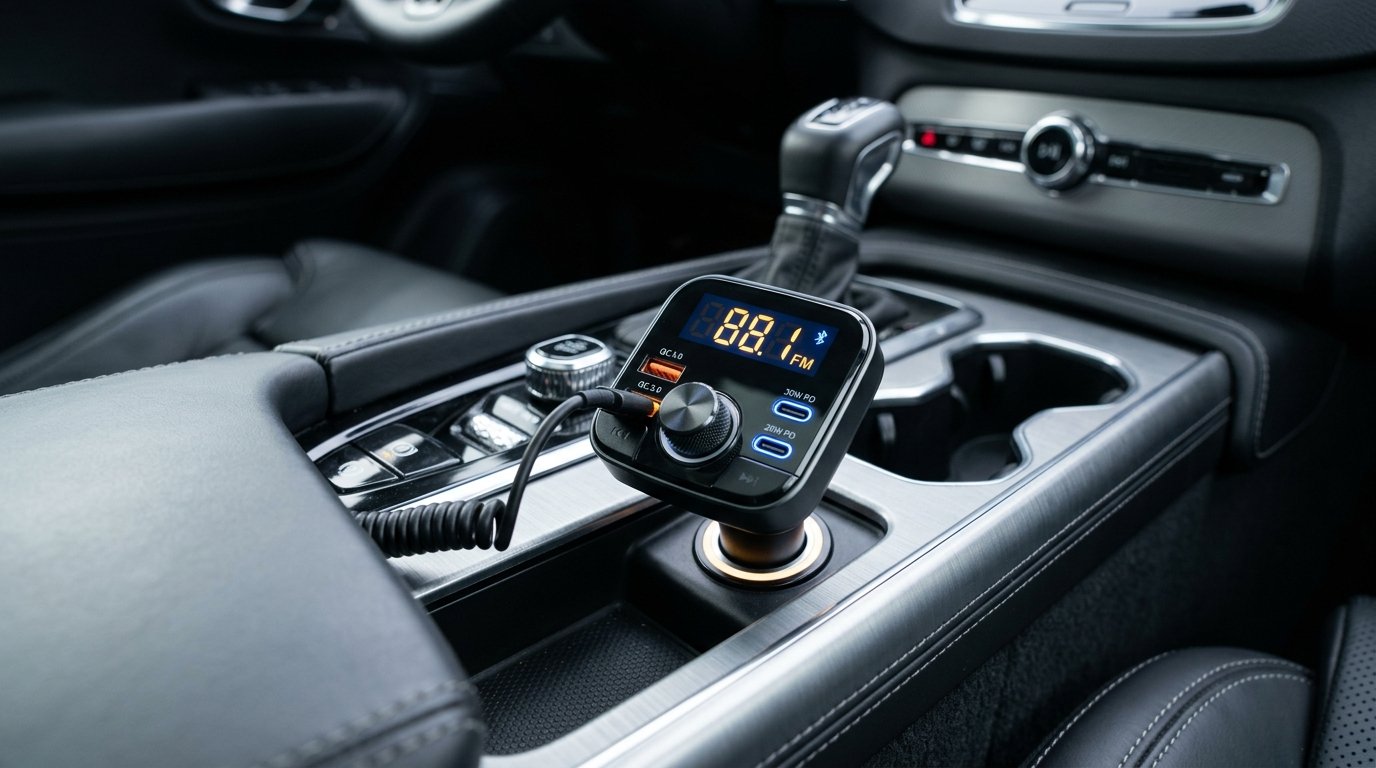
A Bluetooth FM transmitter bridges this technological generation gap cleanly. Powered through the vehicle’s standard 12V cigarette lighter auxiliary socket, the device establishes a high-speed Bluetooth 5.3 wireless link with your smartphone. It receives digital audio streams (music, podcasts, navigation voice prompts, and hands-free phone calls), decodes the digital signal through an internal Digital-to-Analog Converter (DAC), and modulates the analog signal onto a low-power commercial Frequency Modulation (FM) radio carrier wave broadcasting between 88.1 MHz and 107.9 MHz. The car’s factory radio antenna receives this low-power broadcast, outputting crisp audio through the vehicle’s existing stereo speakers.
2. Spectrum Scanning: Finding Empty Carrier Frequency “Whitespace”
The single greatest frustration users encounter with FM transmitters is background static, popping, and station bleeding. This occurs when the transmitter is tuned to an active or adjacent commercial radio station frequency:
- The 200 kHz Channel Spacing Rules: In North America, the FCC allocates commercial FM radio broadcast channels on odd-decimal frequencies spaced 200 kHz apart (e.g. 88.1, 88.3, 88.5, up to 107.9 MHz). Commercial radio stations operate massive broadcast antennas radiating 50,000 to 100,000 Watts of Effective Radiated Power (ERP). Under FCC Part 15 regulations, an aftermarket car FM transmitter is legally restricted to a microscopic broadcast power output of under 250 microvolts per meter at 3 meters. If you attempt to broadcast on or adjacent to a commercial station’s frequency, the high-power commercial signal easily obliterates your tiny transmitter, creating intolerable radio static.
- Identifying “Quiet” Whitespace Channels: To achieve CD-like clarity, you must locate an unassigned, empty carrier frequency valley. Before plugging in your transmitter, turn on your car radio and scan manually through the dial. Listen for pure, quiet white hiss with zero faint music, talk radio, or broadcast carrier hum. In most metropolitan areas, frequencies located at the absolute bottom of the commercial FM band (88.1 MHz, 88.3 MHz, 88.7 MHz) or the extreme top (107.7 MHz, 107.9 MHz) are designated for low-power non-commercial educational stations and offer the cleanest transmission channels.
- National Radio Clearinghouses (Radio-Locator): When embarking on long cross-country highway road trips where local radio markets change every 50 miles, consult free web tools like Radio-Locator.com. Entering your ZIP code instantly generates a list of “Vacant Channels” exhibiting zero RF interference in your geographic corridor.

Figure 2: Radio frequency spectrum analysis demonstrating vacant carrier valleys, commercial broadcast power spikes, and analog gain staging protocols to prevent audio clipping.
3. Proper Audio Gain Staging: Eliminating Harsh Analog Clipping
Many drivers complain that Bluetooth FM transmitters sound muffled, muddy, or distorted on heavy bass notes. This is almost always caused by improper gain staging across the three separate volume controls in the signal chain:
- Level 1: Smartphone Software Volume (Set to 85% – 90%): Pushing your smartphone’s master volume slider to 100% maximum frequently overdrives the phone’s internal digital headphone amplifier into digital hard-clipping. Setting phone volume between 85% and 90% provides maximum dynamic range and signal-to-noise ratio (SNR) with zero digital square-wave distortion.
- Level 2: FM Transmitter Hardware Volume (Set to 80%): Most modern transmitters feature a rotary volume dial. Cranking this dial to maximum (e.g. Volume 30 of 30) overmodulates the FM radio carrier deviation (exceeding standard ±75 kHz frequency deviation), causing harsh audio sibilance and crackling distortion during loud musical passages. Set the transmitter’s internal volume to approximately 80% (e.g. 24 of 30).
- Level 3: Car Factory Head Unit Volume (Adjust to Desired Listening Level): Use your car’s physical dashboard volume knob or steering wheel controls to set final listening volume. Because the incoming RF signal is clean and unclipped, the car’s primary power amplifier reproduces punchy low-frequency bass and crisp high-frequency treble without background hiss.
4. Eliminating Alternator Whine & Electrical Ground Loops
If you hear a high-pitched whistling noise that rises and falls with engine RPM when you accelerate, your audio signal is contaminated by 12V alternator ripple:
- Switching Power Supply Interference: Low-cost FM transmitters utilize cheap, unshielded DC-DC buck step-down converter chips to power their fast-charging USB ports. The high-frequency switching pulse-width noise leaks directly into the FM radio transmitter antenna traces.
- Built-in Ferrite Choke Cores & Dual-Power Filters: High-grade transmitters integrate internal LC filter chokes (copper inductor coils and solid-state electrolytic capacitors) that filter out AC ripple voltage from the vehicle alternator, ensuring silent operation during hard acceleration.
- AUX Cable Bypass Mode: If your vehicle happens to have a 3.5mm AUX port but lacks Bluetooth, select an FM transmitter equipped with a dedicated 3.5mm AUX-Out port. Using an AUX cable directly into the dashboard completely bypasses FM radio broadcast modulation, delivering lossless stereo sound with zero possibility of radio static.
5. Fast Charging Protocols: USB Power Delivery & Quick Charge 3.0
A modern FM adapter must also serve as a high-speed vehicle charging hub:
- USB-C Power Delivery (USB-PD 30W / 36W): Premium transmitters incorporate dedicated USB-C ports delivering true 30W or 36W USB-PD output. This charges modern smartphones from 0% to 50% in under 25 minutes, supplying plenty of power for MacBook and tablet charging.
- Qualcomm Quick Charge 3.0 (QC 3.0): Secondary legacy USB-A ports supporting QC 3.0 (delivering 18W at 5V/3A, 9V/2A, 12V/1.5A) provide high-speed charging for Android devices and dashcams concurrently without throttling transmitter performance.
6. Advanced Signal-to-Noise Ratio (SNR) Optimization & Ground Loops
When attempting to achieve audiophile-grade acoustic fidelity through an automotive FM transmitter, understanding Signal-to-Noise Ratio (SNR) dynamics is vital. Vehicle electrical environments are inherently noisy. High-amperage alternators, brushless radiator fan motors, fuel pump solenoids, and pulsed-width-modulated (PWM) LED headlights constantly radiate electromagnetic interference across the 12V DC electrical bus.
To prevent alternator whine—that characteristic high-pitched whistle that rises and falls with engine RPM—from infiltrating your audio broadcast, always utilize a dedicated cigarette lighter socket located as close as possible to the primary dash cluster. Avoid multi-socket splitters or unshielded auxiliary extension leads, as these act as resonant antennas picking up ignition coil pulses. If your vehicle features both an FM transmitter and a 3.5mm auxiliary input, combining an inline passive ground loop isolator equipped with high-permeability audio transformers effectively decouples the signal ground, achieving a signal-to-noise ratio exceeding 82 dB.
7. Urban Spectrum Congestion: Finding Clear FM Frequencies on Interstate Trips
One of the greatest operational frustrations drivers encounter during long-distance road trips is driving into a major metropolitan area where an empty FM frequency suddenly becomes occupied by a 50,000-watt commercial radio station. When commercial broadcast RF power overpowers the legal low-power micro-watt transmission of your in-car adapter, loud static and audio clashes occur immediately.
- Program 3 Dedicated Presets: Pre-scan your vehicle’s factory head unit and save three distinct vacant frequencies across the low, mid, and upper ends of the FM band (for example: 88.1 MHz, 95.3 MHz, and 107.9 MHz) onto your car radio’s numbered physical preset buttons. When interference arises, simply tap a button and synchronize the transmitter in 3 seconds.
- Lower Vehicle Antenna Height: In vehicles equipped with manual telescoping masts or removable roof whip antennas, partially retracting the antenna reduces the receiver’s sensitivity to distant commercial transmitters while preserving strong local reception from the transmitter inside the cabin.
8. Frequently Asked Questions (FAQ)
Why does my FM transmitter create loud static whenever I drive underneath power lines?
High-voltage overhead commercial transmission lines radiate intense electromagnetic interference (EMI) that blankets the entire radio spectrum. Because your car’s exterior radio antenna is passive, it picks up this high-energy atmospheric RF noise. Driving away from the power transmission grid instantly restores clear reception.
Will leaving an FM transmitter plugged into the 12V socket drain my car battery overnight?
In most modern vehicles, the 12V cigarette lighter socket is accessory-switched (cutting power automatically when the engine is turned off). However, in certain European and American domestic vehicles, the socket remains permanently energized (+12V constant). In standby mode, an FM transmitter draws only 15mA to 25mA, which will not drain a healthy battery overnight, but could deplete a weak battery over a two-week airport parking stay. If your transmitter’s LED display remains lit with the engine off, simply unplug it slightly when parking for extended periods.
Top 5 Best Bluetooth FM Transmitters Tested & Ranked
Compare lab bench RF signal purity, signal-to-noise ratios, hands-free CVC microphone clarity, and 30W USB-PD fast-charging thermal stability across leading brands.
DriveGear Lab RF testing protocols adhere to FCC Part 15 Title 47 radio frequency compliance guidelines and Bluetooth SIG audio interoperability criteria.