Rideshare Dash Cam Guide for Uber & Lyft Drivers: Cabin Infrared Recording, Audio Consent Laws & Security
Operating as a professional driver on commercial rideshare platforms like Uber, Lyft, and delivery services requires forensic evidence protection. This technical legal guide details dual-lens and triple-channel dashcam optical sensor selection, 940nm stealth infrared night vision, state wiretapping audio consent statutes, high-endurance memory card write wear, and cloud telematics sync.
1. The Vulnerability of Rideshare Driving: Why Standard Dashcams Fail
Driving rideshare for platforms like Uber, Lyft, or delivery fleets exposes drivers to unique commercial risks that traditional forward-facing dashcams cannot address. While a forward-facing camera documents traffic collisions, intersections, and fraudulent pedestrian staged accidents, the vast majority of severe rideshare disputes occur inside the vehicle cabin.
False passenger sexual harassment claims, fraudulent assault allegations, intoxicated rider property damage, fare evasion disputes, and verbal altercations can instantly deactivate a driver’s livelihood within minutes of an automated passenger report. A commercial rideshare dashcam must concurrently document high-resolution forward road traffic and complete 180-degree interior cabin activity in pitch-black darkness, while preserving legally admissible audio evidence that withstands courtroom and platform scrutiny.
2. Cabin Optics: 850nm vs. 940nm Stealth Infrared Night Vision
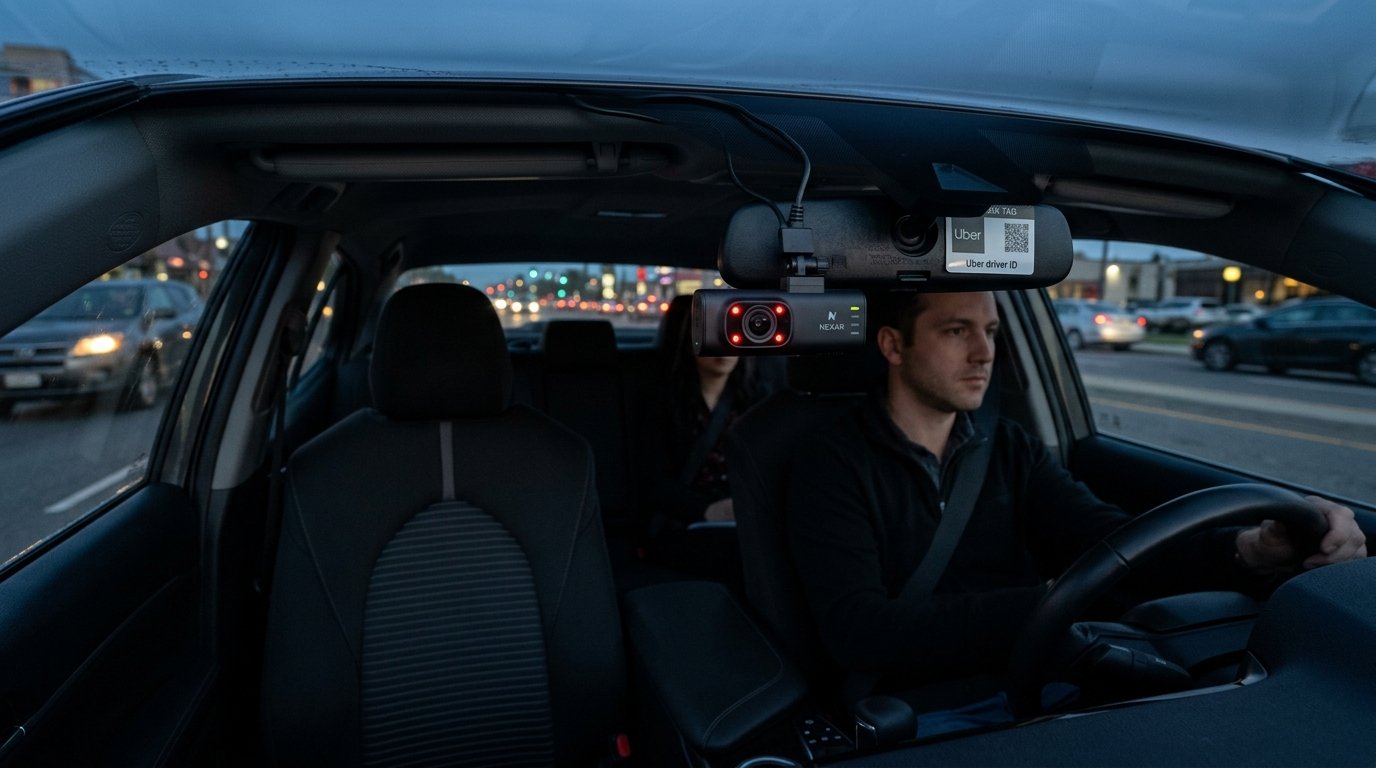
Human eyes cannot see in unlit vehicle cabins at night, and standard camera image sensors produce pure black static without supplementary light. Rideshare cabin cameras incorporate active Infrared (IR) light-emitting diodes (LEDs) paired with optical IR-cut filter glass:
- 850nm Wavelength Infrared (Semi-Visible Red Glow): Standard consumer IR cameras operate at an 850-nanometer optical wavelength. While highly sensitive to CMOS sensors and capable of casting light into rear passenger seats, 850nm LEDs emit a faint, visible red glow. Intoxicated or belligerent riders often fixate on the glowing red dots, sometimes becoming agitated or attempting to physically cover the camera lens.
- 940nm Wavelength Infrared (Stealth Illumination): Professional commercial fleet dashcams utilize 940-nanometer “stealth” IR LEDs. Light emitted at 940nm is completely invisible to human eyes, casting zero visible red glow while illuminating the entire cabin interior in crisp monochrome detail on the camera’s Sony STARVIS sensor.
- Dynamic Mechanical IR-Cut Filter Switching: In daylight, infrared light distorts natural color palettes (making green foliage appear pink). High-end rideshare dashcams feature an internal solenoid-actuated mechanical IR-cut filter that slides into place during daylight to render true 24-bit color, then automatically retracts with an audible click at dusk to maximize infrared monochrome sensitivity.
3. The Legal Landscape: US State Wiretapping & Audio Consent Laws
While recording silent video inside your personal motor vehicle in public spaces is universally protected under US common law, recording audio conversations inside an enclosed vehicle cabin is governed by strict state wiretapping and eavesdropping statutes:
- One-Party Consent Jurisdictions (Majority of US States): In approximately 38 US states and federal jurisdictions, you are legally permitted to record in-person conversations as long as at least one party to the conversation consents (which can be you, the driver). You are not strictly required by state criminal law to disclose audio recording to passengers.
- All-Party / Two-Party Consent States (Strict Legal Mandate): In approximately 12 states—including California, Florida, Illinois, Pennsylvania, Massachusetts, Washington, Maryland, Michigan, Montana, New Hampshire, Connecticut, and Delaware—recording audio without the express consent of all persons inside the vehicle can constitute a criminal wiretapping felony and renders all audio recording inadmissible in civil arbitration!
- The Evidentiary Warning Window Decal: In two-party consent states, the legal standard requires establishing “no reasonable expectation of privacy.” Adhering bright, prominent passenger window warning decals stating: “NOTICE: For safety and security, this vehicle is monitored by 24-hour dual audio and video recording equipment. Entry into this vehicle constitutes explicit consent” establishes legal notice under implied consent doctrine. When passengers read the sticker and willingly enter the vehicle, courts have ruled they forfeit expectations of private oral communication.
- Uber & Lyft In-App Dashcam Registration: Both Uber and Lyft allow drivers to register their dashcam serial numbers inside the driver partner portal. When registered, the rideshare app automatically sends an automated push notification to the rider’s phone upon dispatch: “Your driver has a dashcam recording for safety.” This provides an ironclad digital consent trail.

Figure 2: United States audio recording consent classification map, required passenger window warning decal wording, and high-endurance memory card wear specifications.
4. Memory Card Endurance: Why Standard MicroSD Cards Burn Out
Rideshare dashcams write two or three continuous, high-bitrate video streams concurrently for 8 to 12 hours every single day:
- NAND Flash Memory Write Wear: Standard consumer micro-SD cards (such as SanDisk Ultra) use low-cost TLC (Triple-Level Cell) or QLC (Quad-Level Cell) flash memory designed for intermittent digital camera bursts. Subjected to continuous 24/7 video loop writing in high-heat automotive environments, TLC cells suffer rapid electron gate degradation, leading to corrupt file sectors, missing critical footage, or complete card lockup within 60 to 90 days.
- High-Endurance MLC and pSLC Architecture: Always deploy specialized High-Endurance or Max-Endurance cards (such as SanDisk High Endurance, Samsung PRO Endurance, or Transcend High Endurance). These cards utilize rugged 3D TLC/pSLC flash controllers rated for over 40,000 to 100,000 continuous video recording hours (measured in hundreds of Terabytes Written / TBW).
- Memory Sizing for Full-Shift Coverage: Dual-channel 1440p front + 1080p cabin recording generates approximately 18GB to 25GB of video per hour. A 128GB card provides only 5 to 6 hours of buffer before loop recording begins overwriting earlier footage. For full 10-hour rideshare shifts, install a 256GB or 512GB High-Endurance card to ensure morning incidents are not overwritten before your evening shift ends.
5. Connected 4G LTE Cloud Telematics & Instant Incident Backup
If a hostile passenger physically yanks your dashcam off the windshield and steals it, local micro-SD storage is completely lost:
- Real-Time Cloud Offloading: Next-generation connected dashcams (such as BlackVue Cloud, Nextbase iQ, or Owlcam) integrate built-in 4G LTE SIM cards. When an aggressive physical impact, high G-force braking event, or manual SOS emergency button is triggered, the camera instantly uploads a tamper-proof 20-second 1080p video clip directly to secure Amazon AWS cloud storage servers within seconds.
- Live Remote View & Geofence Tracking: Connected systems enable remote GPS tracking, geofence boundary alerts, and live audio/video streaming directly to a smartphone app, providing invaluable protection if the vehicle is carjacked or stolen during a shift.
6. Thermal Reliability: Supercapacitors vs. Swelling Lithium Batteries
Commercial rideshare vehicles spend 8 to 14 hours parked or driving directly under blazing summer sun, where windshield glass temperatures regularly climb past 150°F (65°C):
- The Catastrophic Failure of Lithium Pouch Cells: Budget consumer dashcams rely on miniature internal lithium-ion pouch batteries to save the last video file when power is disconnected. Under extreme cabin solar heat soak, lithium batteries undergo chemical electrolyte breakdown. The cells expand, “pillowing” and swelling until they crack the camera’s plastic housing, pop the LCD screen out of its frame, or suffer internal thermal runaway that poses serious fire hazards!
- Electric Double-Layer Supercapacitors (EDLC): Professional commercial dashcams replace volatile lithium batteries with high-reliability automotive supercapacitors. Supercapacitors store electrical charge electrostatically rather than chemically, operating safely across extreme temperature ranges from -4°F to 158°F (-20°C to 70°C). They withstand hundreds of thousands of charge-discharge cycles without capacity degradation, ensuring your camera safely finishes writing the final video file even during a catastrophic high-impact collision where vehicle battery power is instantly severed.
7. De-Escalation Protocol & Evidentiary Chain of Custody
How you handle forensic video evidence following a severe passenger altercation determines whether your account is reinstated or permanently deactivated:
- Preserving Uncut Raw Footage: Never edit, trim, or filter video evidence before submitting it to rideshare safety support teams or law enforcement investigators. Trimmed or audio-muted video files can be challenged in legal proceedings as tampered evidence under judicial spoliation doctrines. Always export the continuous, unedited MP4 container including the complete 10 minutes preceding the incident.
- GPS Coordinates and G-Sensor Telemetry Overlays: Ensure your dashcam’s firmware overlay permanently burns the vehicle’s exact GPS latitude/longitude coordinates, speed (MPH), date, and millisecond timecode directly into the lower video border. This creates verifiable forensic corroboration proving vehicle location and vehicle velocity during disputed allegations.
8. Frequently Asked Questions (FAQ)
Can a rider legally demand that I turn off my cabin dashcam?
No. As an independent contractor operating your privately owned vehicle, you have full constitutional property rights to record your workspace for personal security and liability protection. If a passenger objects to being recorded, politely inform them that company policy allows them to cancel the ride, exit the vehicle safely, and request another driver. Never compromise your safety by turning off the camera.
How do I submit dashcam video to Uber or Lyft support after a dispute?
Do not wait for platform deactivation! Immediately export the MP4 clip via Wi-Fi to your smartphone, trim the video to include 60 seconds before and after the altercation, and upload it via the driver support ticket. Having timestamped GPS coordinates, forward speed, and unedited cabin audio provides undisputed corroborating evidence that resolves claims in your favor.
Top 5 Best Dual-Facing Rideshare Dash Cams Benchmarked
Compare lab test results across leading dual and triple-channel dashcams evaluating Sony STARVIS 2 low-light noise, stealth 940nm IR cabin clarity, cloud connectivity, and G-sensor sensitivity.
DriveGear Lab rideshare telematics testing protocols adhere to National Institute of Standards and Technology (NIST) digital video evidentiary handling procedures and ISO 9001 quality guidelines.