Amber vs Pure White Fog Lights: Why Yellow Light Cuts Through Dense Fog, Rain, and Snow Without Glare
Driving through dense atmospheric fog, driving blizzards, torrential rain, and dust storms requires specialized optical beam management. This technical guide explores atmospheric light scattering physics (Rayleigh vs Mie scattering), 3000K selective yellow vs 6000K cool white Kelvin color temperatures, human retinal scotopic contrast, SAE J583 wide flat beam cutoff patterns, and bumper mounting aerodynamics.
1. Atmospheric Scattering Physics: Why Cool White Light Blinds in Fog
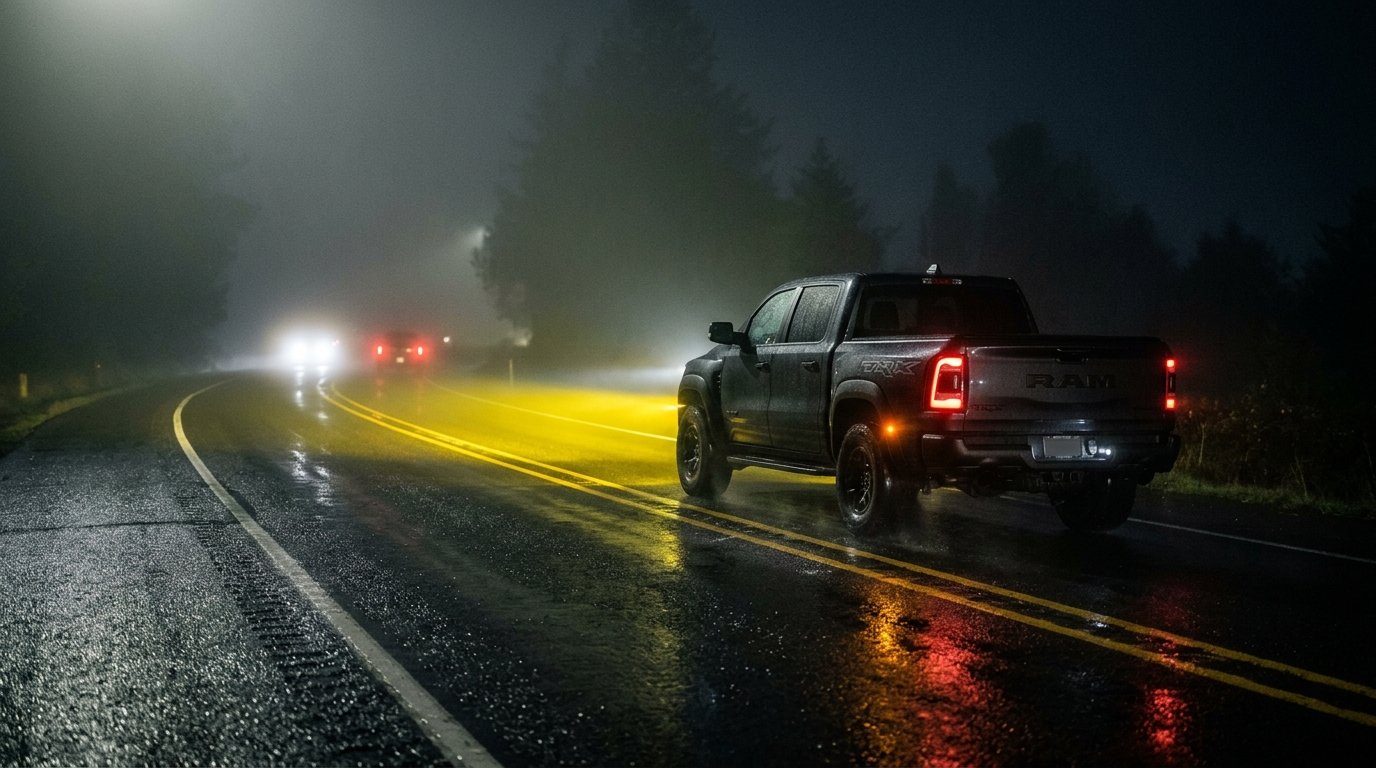
When driving through dense fog, heavy snowfall, or torrential rainstorms at night, turning on your high-beam headlights or high-power 6000K/6500K cool white LED bulbs often worsens forward visibility. Instead of illuminating the road, the driver is confronted by an impenetrable, blinding “white wall” of glare hovering directly in front of the windshield.
To understand why this optical phenomenon occurs, we must examine atmospheric particle scattering physics. Fog consists of microscopic suspended liquid water droplets ranging from 1 to 20 micrometers (μm) in diameter. When photons of light encounter these suspended water particles, two distinct scattering regimes govern light propagation:
- Rayleigh Scattering (Wavelength-Dependent): Rayleigh scattering occurs when airborne particles are significantly smaller than the wavelength of visible light. According to Rayleigh’s law, scattering intensity is inversely proportional to the fourth power of the wavelength. Shorter optical wavelengths in the violet and blue spectrum (around 400nm to 450nm) scatter approximately ten times more aggressively than longer yellow, amber, and red wavelengths (around 580nm to 650nm). Cool white 6000K LEDs contain massive peak energy in the 450nm royal blue spectral band, which violently scatters off fine airborne moisture back into the driver’s eyes!
- Mie Scattering (Aerosol Droplet Reflection): When water droplets are comparable to or larger than visible light wavelengths (such as dense ground fog droplets and raindrops), Mie scattering dominates. While Mie scattering is relatively non-wavelength-selective across the pure spectrum, the human visual system processes reflected monochromatic amber light far differently than broad-spectrum cool white light.
2. Retinal Visual Processing: The Physiological Advantage of 3000K Selective Yellow
Beyond pure atmospheric physics, the human eye’s retinal neuro-architecture explains why 3000K Selective Yellow is vastly superior for adverse weather driving:
- Chromatic Aberration and Blue Light Dispersion: The human cornea and crystalline lens cannot focus all optical colors onto the exact same retinal focal plane simultaneously. Blue light (400nm-480nm) refracts at a much steeper angle than yellow and amber light (580nm-600nm), focusing slightly in front of the retina. This induces natural optical chromatic aberration, perceived by the brain as visual “fuzziness”, haloing, and optical glare around light sources.
- Retinal Veiling Luminance: When blue light scatters across the vitreous humor inside the eyeball, it produces “veiling luminance”—a background wash of stray light that dramatically reduces retinal contrast sensitivity. By eliminating the high-energy blue peak (using selective yellow 3000K amber filtration), veiling luminance drops by over 35%, allowing the driver’s optic nerve to distinguish asphalt surface textures, lane stripes, and road debris with crystal clarity.
- Visual Fatigue and Pupil Constriction: High-kelvin blue/white backscatter triggers rapid photopic pupil constriction, diminishing peripheral vision into the dark road shoulders. Amber yellow light maintains wider pupil dilation without inducing eye fatigue during exhausting multi-hour night drives through severe blizzards.

Figure 1: Optical physics comparison of 6000K Cool White vs 3000K Selective Yellow fog light propagation through airborne water droplets, detailing Rayleigh scattering curves and driver backscatter glare.
3. SAE J583 Standards & Razor-Sharp Cutoff Optics
A high-quality fog light is defined far more by its optical beam pattern and beam cutoff geometry than by raw lumen output:
- The Critical Low Mounting Position: Natural ground fog rarely touches the pavement directly; a microscopic thermal gap of clear air (typically 12 to 24 inches above the asphalt) exists because the ground radiates residual daytime thermal heat. Fog lights must be mounted low in the vehicle’s bumper fascia to project under this ground fog blanket.
- SAE J583 Flat Horizontal Cutoff: The Society of Automotive Engineers (SAE) standard J583 specifies a very wide (up to 70-degree spread), extremely flat horizontal beam pattern with a razor-sharp top cutoff shield. Zero light is permitted to project upward into the fog layer above the bumper line. Any upward stray light rays immediately hit suspended fog droplets and bounce straight back into the driver’s eyes.
- Projector Lenses vs. Multi-Reflector Cups: Aspherical glass projector fog housings equipped with internal optical cut-off shields provide significantly crisper horizontal cutoff edges than open multi-surface reflector bowls, preventing foreground pooling and eliminating glare for oncoming oncoming motorists.
4. LED Chip Phosphors: Dichroic Glass Filters vs. Native Amber Chips
How manufacturers produce 3000K yellow light has a massive impact on usable optical lux on the road:
- Cheap Yellow Tinted Lenses (Subtractive Filtering): Budget aftermarket kits take standard 6000K cool white LED bulbs and cover them with yellow-tinted glass tubes or plastic lenses. This is a subtractive optical filter that physically blocks 30% to 45% of total light output, turning trapped photons into wasted heat inside the housing.
- Native 3000K Golden Phosphor LED Emitters: Premium automotive LED bulbs (such as Nichia, Osram, and Lumileds Golden Yellow automotive-grade chips) use specialized chemical phosphor blends deposited directly onto the semiconductor die. The LED natively emits true 3000K selective yellow light at peak optical efficiency, delivering 100% of generated lumens directly through clear optical projector lenses.
- Dual-Color Switchback LED Bulbs: Innovative switchback fog bulbs feature dual LED chipsets (both 6000K white and 3000K amber) on opposite sides of a copper substrate. By toggling the vehicle fog light switch off and on within 2 seconds, the internal driver circuit switches color modes seamlessly—allowing clean 6000K white styling for clear dry nights, and instant 3000K amber yellow penetration when rain or fog rolls in.
5. Thermal Dissipation and IP68 Environmental Sealing
Because fog lights reside in the lowest, most hostile zone of your vehicle’s bumper fascia:
- Road Debris, Salt & Water Submersion: Low-mounted fog lights endure direct high-speed bombardment from gravel, road salt, slush, and deep standing puddle water immersion. Always insist on housings certified to IP68 or IP69K waterproof standards, featuring breathable waterproof Gore-Tex vent membranes that allow moisture vapor to escape without permitting liquid water intrusion.
- Active Cooling Fans vs. Passive Cast Aluminum Heat Sinks: High-RPM cooling fans mounted in open bumper cavities can jam when caked in frozen winter slush or mud. For low-bumper fog light installations, passive cold-forged 6063 aviation aluminum heat sinks with deep cooling fins provide bulletproof thermal reliability with zero moving mechanical parts to seize up.
6. Vertical Alignment and Aiming Calibration on a 25-Foot Wall
Even the highest-end LED fog light will blind oncoming drivers and fail to illuminate the road if aimed incorrectly:
- Park the vehicle on a level concrete surface facing a flat vertical wall exactly 25 feet (7.62 meters) away.
- Measure the exact height from the ground to the optical center of the fog light lens on the vehicle bumper (e.g., 18 inches).
- On the wall, mark a horizontal line with masking tape exactly 4 inches lower than the measured fog light center (e.g., 14 inches from the ground).
- Rotate the vertical aiming screw on the rear of the fog light bracket until the sharp top cutoff line of the beam rests directly on or slightly below the tape mark. This ensures a 1.0-degree downward trajectory that sweeps across the pavement without blinding oncoming traffic.
7. Yellow Vinyl Film Laminates vs. Native 3000K LED Emitters
A frequent DIY approach to achieving amber fog lights is applying yellow adhesive vinyl protective film (such as Lamin-X or 3M VentureShield) over factory white fog light lenses:
- Optical Transmission Loss and Subtractive Filtration: Applying yellow PVC or polyurethane film over a clear lens acts as a band-pass optical barrier. While it successfully blocks high-frequency blue photons, it also absorbs substantial green and red light, resulting in a 25% to 35% reduction in total forward lux. Furthermore, trapped thermal energy cannot escape as easily through the thick vinyl skin, raising internal lens temperatures.
- Native Amber Semiconductor Phosphor Dominance: High-grade native 3000K LED bulbs emit pure amber photons directly from the gallium-nitride (GaN) semiconductor die using high-efficiency yellow phosphors. Because 100% of the light output passes unimpeded through crystal-clear polycarbonate or glass lenses, native LED bulbs deliver twice the usable ground-sweeping lux compared to film-tinted setups, with zero risk of film peeling or bubbling under high-pressure automated car washes.
8. Frequently Asked Questions (FAQ)
Are amber yellow fog lights street legal across the United States?
Yes. Under United States Federal Motor Vehicle Safety Standard 108 (FMVSS 108) and SAE J583, auxiliary fog lamps are legally permitted to emit either white or selective yellow light. Selective yellow is fully street-legal in all 50 states and throughout Europe under UNECE regulations.
Can I use fog lights as replacement headlights for normal night driving?
No. Fog lights are engineered to project a very wide, short-range beam extending only 30 to 50 feet ahead of the vehicle bumper. Driving at highway speeds using only fog lights creates dangerous “tunnel vision” with virtually zero long-range forward illumination. Fog lights are strictly auxiliary lighting designed to supplement low-beam headlights during severe inclement weather.
Top 5 Best LED Fog Light Bulbs Tested & Ranked
Compare lab bench photometric lux measurements, 3000K vs 6000K adverse weather visibility, IP68 water submersion durability, and Canbus error-free decoders across leading brands.
DriveGear Lab automotive optical testing protocols adhere to SAE J583 front fog lamp standards and FMVSS 108 photometry compliance specifications.