
How to Test Car Battery Health & Alternator Charging: Digital Conductance vs Load Testing Guide
Diagnosing 12V lead-acid, AGM, and EFB automotive starting batteries requires evaluating internal electrochemical conductance rather than relying solely on resting surface voltage. This comprehensive diagnostic guide explores digital AC micro-load conductance testing vs carbon pile resistive load testing, Cold Cranking Amps (CCA) plate sulfation, starter cranking voltage drop, and alternator diode bridge AC ripple analysis.
1. The Illusion of Resting Voltage: Why Multimeters Deceive
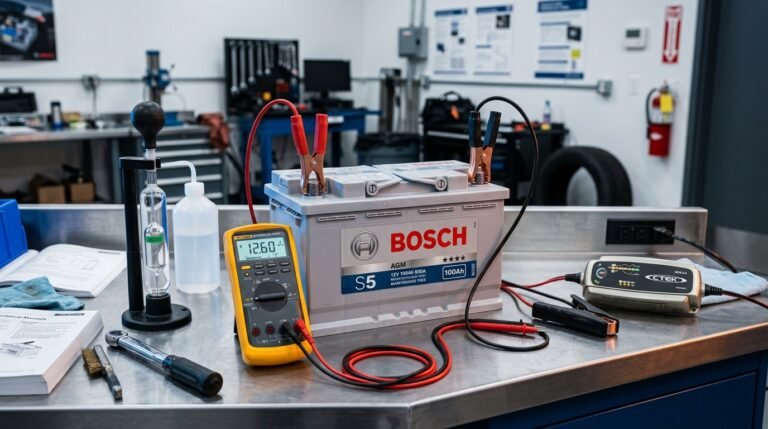
When a vehicle struggles to crank over or suffers from mysterious electrical glitches, the most common troubleshooting mistake is connecting a standard digital multimeter across the battery posts and declaring the battery “healthy” simply because the meter reads 12.60 Volts.
In automotive electrochemistry, resting voltage only reveals State of Charge (SOC); it reveals virtually nothing about State of Health (SOH) or true Cold Cranking Amperage capacity. A severely aged, heavily sulfated car battery with 80% of its internal lead plate surface area eroded away can still display an idyllic resting voltage of 12.6V if fully charged. However, the microsecond the starter solenoid engages—demanding a massive 300 to 500 amps of inrush current—the battery’s internal electrical resistance causes terminal voltage to instantly collapse below 8.0V, leaving the engine clicking dead!
Accurately determining whether a battery is healthy, dying, or sulfated requires measuring its internal electrochemical plate conductance under specialized test parameters.
2. Testing Methodologies: Digital Conductance Analyzers vs. Carbon Pile Load Testers
Automotive repair facilities utilize two vastly different diagnostic technologies, each with distinct physical principles:
- Traditional Carbon Pile Load Testers (Heavy Physical Load): For decades, the industry standard was a heavy carbon pile tester. The operator turns a large rotary compression screw that crushes a stack of carbon disks, applying a massive physical resistive load equal to half the battery’s Cold Cranking Amps (CCA) rating (e.g. applying a continuous 350-amp load to a 700 CCA battery) for exactly 15 seconds while observing an analog voltmeter. If voltage stays above 9.6V at 70°F (21°C), the battery passes. However, carbon pile testing generates blistering heat, creates dangerous sparking hazards near explosive battery hydrogen gas vents, and cannot test discharged batteries (requiring hours on a charger before testing can even begin).
- Modern Digital AC Conductance Analyzers (The Midtronics Standard): Advanced digital testers (such as TOPDON, FOXWELL, Autel, and Midtronics) utilize patented AC conductance technology. The analyzer injects a safe, high-frequency, low-amperage AC micro-signal (typically around 100 Hz) through the battery cells using 4-wire Kelvin test leads. By measuring the minute AC voltage response, the microprocessor calculates pure internal electrical conductance (measured in Siemens, the inverse of resistance, \(G = 1/R\)). Because lead plate sulfation and active material shedding directly degrade plate surface area and conductance, the tool calculates available Cold Cranking Amps (CCA) in under 3 seconds with zero heat, zero battery discharge, and zero safety hazards!

Figure 4: Comprehensive technical comparison between non-destructive digital AC conductance testing and high-amperage carbon pile resistive load testing.
3. Decoding Battery Chemistry: Flooded, AGM, and EFB
Modern vehicles equipped with automatic engine start-stop systems require specific battery chemistry selection on your diagnostic tester:
- Standard Flooded Lead-Acid: Traditional automotive batteries containing liquid sulfuric acid electrolyte surrounding lead antimony/calcium plates.
- Absorbent Glass Mat (AGM): The sulfuric acid electrolyte is completely absorbed into micro-fiberglass mat separators compressed tightly between lead plates. AGM batteries feature significantly lower internal resistance (often under 3 milliohms), allowing higher discharge rates and superior cyclic lifespan. Testing an AGM battery on a standard “Flooded” test setting produces erroneous CCA calculations!
- Enhanced Flooded Battery (EFB): Optimized flooded batteries featuring polyester scrims on positive plates, commonly found in entry-level start-stop vehicles. Always select the exact chemistry stamped on the battery case.
4. Cranking System Voltage Drop Testing
Evaluating whether starting issues originate in the battery or a failing starter motor:
- Connect the digital battery tester to the battery terminals and select Cranking Test mode.
- Crank the vehicle engine. The tester monitors real-time millisecond voltage drop.
- Healthy Cranking Threshold: During healthy engine cranking, battery voltage should momentarily drop but remain firmly above 9.60 Volts (typically between 10.0V and 10.8V). If cranking voltage plummets below 9.0V, the starter motor’s internal bushings or windings are dragging (drawing excessive current), or the battery has reached end-of-life.
5. Alternator Charging & Diode Ripple Diagnostics
A dying alternator can ruin a brand new car battery in weeks:
- Loaded vs. Unloaded Charging Voltage: With the engine idling, healthy alternator output should measure between 13.8V and 14.5V. Turning on high-load accessories (high-beam headlights, rear window defroster, and maximum blower fan) should not drop voltage below 13.5V. If voltage drops below 13.2V, the alternator’s voltage regulator or stator windings are failing.
- Alternator Diode Ripple Voltage: Alternators generate 3-phase Alternating Current (AC) that is converted into Direct Current (DC) by an internal 6-diode rectifier bridge. If one diode blows open or shorts out, raw AC ripple voltage leaks onto the vehicle’s 12V DC electrical rail. Digital testers measure this AC ripple: AC ripple must remain below 0.50V (500mV). Excessive AC ripple induces severe radio static, scrambles sensitive vehicle CAN-bus modules, and rapidly cooks the battery plates through continuous microscopic reverse-polarity cycling.
6. State of Charge (SOC) vs. State of Health (SOH): Decoding Diagnostic Metrics
A frequent point of confusion among vehicle owners and novice technicians is the fundamental distinction between battery State of Charge (SOC) and battery State of Health (SOH). A battery can be charged to 100% SOC (reading 12.68 volts open-circuit) while possessing a degraded SOH of only 35%.
While State of Charge reflects the temporary thermodynamic concentration of sulfuric acid in the electrolyte relative to available lead sulfate, State of Health reflects the permanent structural condition of the internal lead grid architecture. Over successive charge cycles, crystalline lead sulfate hardens into non-conductive passive barriers across the plate surfaces, while thermal expansion causes positive active material (lead dioxide) to detach and fall to the sediment chamber at the bottom of the cell. Modern digital conductance analyzers separate these parameters instantly:
- SOH > 80% (Green / Good Battery): Full plate surface area intact, micro-conductance aligns with factory rating, internal resistance typically between 2.5 mΩ and 4.5 mΩ. The battery can safely sustain demanding winter cranking.
- SOH 50% – 79% (Yellow / Recharge & Retest): Moderate sulfation present. Cranking speed may hesitate during freezing sub-zero mornings. Clean terminals, apply a desulfating smart charger, and re-evaluate.
- SOH < 50% (Red / Replace Immediately): Critical plate degradation, severe active material shedding, or high risk of sudden open-circuit internal cell bridge failure. Immediate replacement is mandatory to prevent getting stranded.
7. Dynamic Diode Ripple & Alternator Rectifier Bridge Testing
Alternators generate three-phase alternating current (AC) that must be converted to direct current (DC) using a bridge of six internal semiconductor silicon diodes. When an individual rectifier diode develops an open circuit or electrical leakage, excessive AC ripple voltage enters the vehicle’s sensitive electrical network. High AC ripple disrupts engine control modules (ECMs), causes erratic sensor readings, and overheats the lead-acid battery. Using a digital battery analyzer with dynamic charging system diagnostics allows you to verify that peak AC ripple remains strictly below the 0.25V AC (250 millivolt) automotive limit during engine rev tests.
8. Laboratory Cranking Voltage Waveform Analysis
During the initial 200 milliseconds of engine cranking, starter motors draw massive inductive inrush currents ranging from 250A to over 600A depending on engine displacement and ambient oil viscosity. A healthy 12V automotive battery will experience a momentary voltage dip down to approximately 9.6V to 10.2V before recovering to above 11.0V as the starter motor spins at steady cranking speed.
If your digital tester records a cranking voltage dip dropping below 9.2 Volts, the vehicle will exhibit sluggish starting or complete solenoid clicking. This low-voltage condition causes the Powertrain Control Module (PCM) to reboot during cranking, frequently generating spurious communication network codes (U0100, U0101) across high-speed CAN buses. Testing both resting conductance and dynamic cranking drop ensures flawless winter reliability.
9. Frequently Asked Questions (FAQ)
Can I test a car battery while it is still installed inside the vehicle?
Yes. Digital conductance analyzers are engineered for in-vehicle testing. Ensure the engine and all electrical accessories are turned off for at least 10 minutes to dissipate the initial surface charge before clamping the Kelvin leads directly to the lead terminal posts. For vehicles with batteries located in the trunk (common in BMW, Mercedes, and Dodge), clamp directly onto the actual battery posts rather than remote engine bay jump-start terminals to avoid resistance errors from lengthy vehicle chassis cables.
What is the difference between CCA and CA ratings on a battery label?
Cold Cranking Amps (CCA) is the critical industry standard: the number of amps a 12V battery can deliver for 30 seconds at 0°F (-18°C) while maintaining at least 7.2 Volts. Cranking Amps (CA / MCA) is tested at a warm 32°F (0°C), resulting in an artificially inflated number (typically 20% to 25% higher). Always input the rated CCA number from the battery placard into your digital tester for accurate health diagnostics.
Top 5 Best Car Battery Testers Tested & Ranked
Compare lab bench testing results across top digital conductance analyzers, evaluating CCA measurement precision, Kelvin clamp resistance, AGM/EFB algorithm accuracy, and alternator ripple detection.
DriveGear Lab battery testing conforms to Battery Council International (BCI) test procedures and SAE J537 storage battery electrical ratings specifications.