
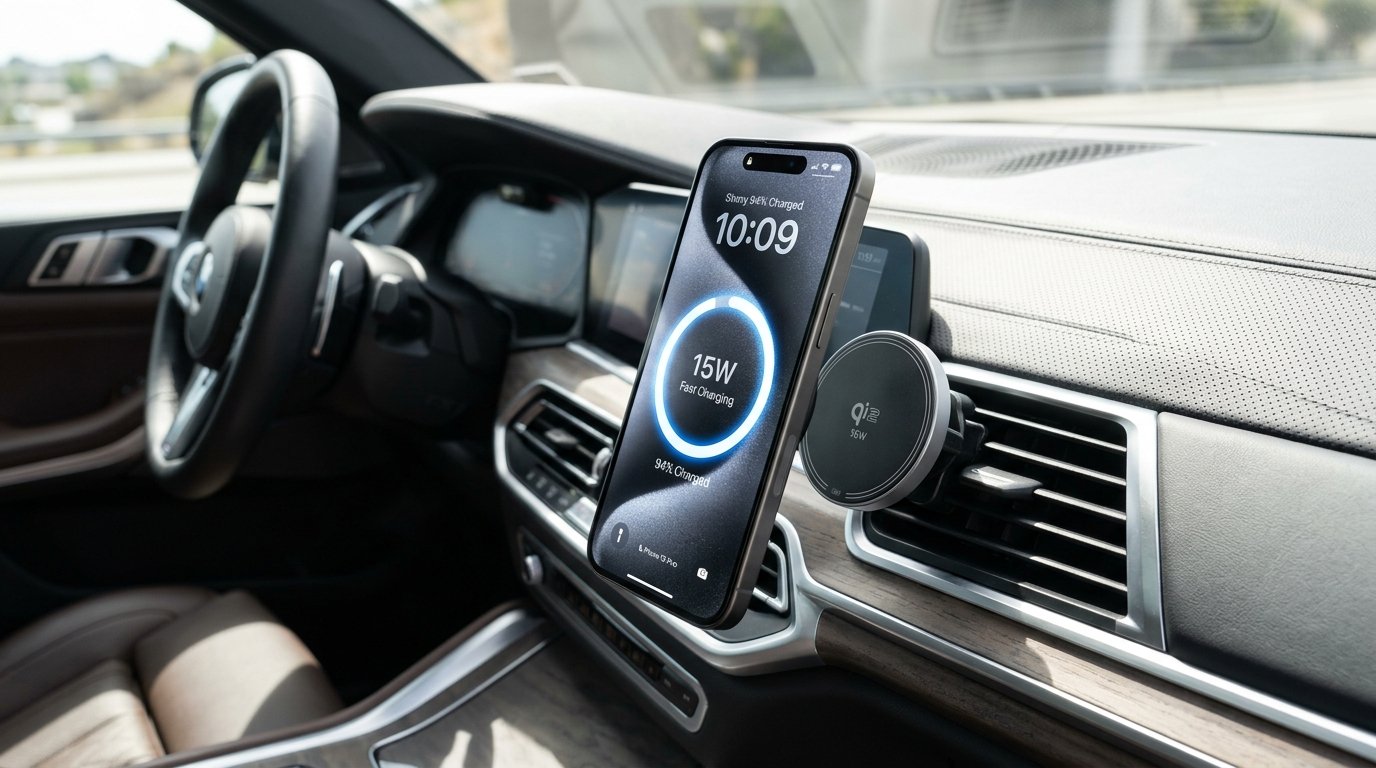
Qi2 vs MagSafe 15W Fast Wireless Charging: Thermal Throttle Protection, CryoBoost Cooling, and Vent Mount Stability
Wireless smartphone charging inside high-temperature automotive cockpits presents unique thermal and electromagnetic hurdles. This technical guide explores the Wireless Power Consortium (WPC) Qi2 standard, the Magnetic Power Profile (MPP), N52 neodymium magnetic retention force, active CryoBoost thermoelectric Peltier cooling, and windshield solar heat throttling mitigation.
1. The Thermal Trap: Why Legacy Qi Wireless Chargers Fail in Cars
For nearly a decade, in-vehicle wireless charging was dominated by legacy Qi v1.2 and v1.3 standards. While convenient, standard non-magnetic flat charging pads or motorized clamp cradles suffer from severe fundamental engineering deficiencies inside moving automobiles.
The primary enemy of wireless charging efficiency is coil misalignment. Inductive power transfer relies on resonant magnetic induction across two planar copper coils: the transmitter coil in the charging mount and the receiver coil inside the phone. When a phone is dropped onto a flat console pad or held loosely in motorized cradle arms, vehicle cornering, braking, and road vibrations cause the phone to shift several millimeters off-center. This radial displacement creates severe magnetic flux leakage. The transmitter must drastically increase drive current to compensate, inducing destructive eddy currents in adjacent metal components. Instead of charging the battery, up to 50% of the electrical energy is converted directly into wasted heat!
When you combine this internal eddy-current heat with direct summer sunlight radiating through a vehicle’s windshield (where dashboard temperatures regularly exceed 150°F / 65°C) and the continuous CPU/GPU load of running GPS navigation apps like Google Maps or Waze with 5G cellular streaming, modern smartphones rapidly reach their internal thermal limit (typically 104°F / 40°C). To protect the lithium-ion battery from catastrophic thermal runaway, the phone’s Power Management Integrated Circuit (PMIC) aggressively throttles wireless charging speeds down from 7.5W to an anemic 2.5W, stops charging entirely, dims the display screen, or triggers an emergency thermal shutdown warning.
2. The Qi2 Standard: Magnetic Power Profile (MPP) & 15W Fast Charging
Ratified by the Wireless Power Consortium (WPC) based on Apple’s proprietary MagSafe technology, the new Qi2 standard represents the biggest leap in wireless charging history:
- The Magnetic Power Profile (MPP): Qi2 mandates a standardized ring of permanent rare-earth magnets surrounding the primary induction coil. When you place a compatible device (iPhone 12 through iPhone 16 series, or next-generation Qi2 Android devices) near the mount, the magnetic attraction automatically snaps the phone into perfect sub-millimeter axial alignment. Zero manual adjustment is required.
- True 15W High-Efficiency Transfer: By eliminating coil misalignment, magnetic coupling efficiency exceeds 85% to 88%. This allows Qi2 mounts to deliver a true, sustained 15 Watts of wireless power to both Apple and Android hardware, cutting vehicle charging times in half compared to legacy 7.5W Qi cradles.
- Full Cross-Platform Interoperability: Unlike proprietary Apple MagSafe accessories that restrict Android devices to slow 5W charging, certified Qi2 mounts establish standardized bidirectional communication handshakes across all certified operating systems, dynamically negotiating 15W fast-charging power profiles.

Figure 1: Architectural analysis of Qi2 Magnetic Power Profile (MPP) vs legacy Qi induction, illustrating coil-to-coil alignment, active cooling fan airflow, and sustained 15W charging power curves.
3. Active Cooling Engineering: CryoBoost & Thermoelectric Heat Dissipation
Magnetic alignment solves coil misalignment, but it does not eliminate ambient solar cabin heat. Next-generation automotive mounts incorporate active cooling architectures:
- Centrifugal Blower Fans (CryoBoost Technology): High-end Qi2 car mounts feature an internal miniature high-RPM centrifugal blower fan integrated directly behind the magnetic mounting plate. The fan pulls cool air through rear intake grilles and blasts high-velocity air across the rear glass surface of the smartphone. This continuous convective cooling keeps phone battery temperatures 15°F to 20°F (8°C to 11°C) cooler during intense GPS navigation, completely preventing thermal charging throttling.
- Solid-State Peltier Thermoelectric Cooling (TEC): Ultra-premium mounts integrate miniature semiconductor Peltier cooling tiles. When electrical current passes through the bismuth-telluride ceramic junctions, heat is pumped away from the front contact plate to rear aluminum cooling fins, actively refrigerating the phone’s back glass to near room temperature even under blazing summer sunlight.
4. Magnetic Retention Physics: N52 Neodymium and G-Force Resistance
A phone falling off a magnetic mount during emergency highway braking maneuvers creates severe driver distraction and potential pedal entrapment:
- N52 Neodymium Magnetic Grade: High-performance car mounts utilize an array of high-coercivity Grade N52 Neodymium (NdFeB) rare-earth magnets arranged in an alternating polarity Halbach array. This concentrates magnetic flux forward into the phone’s internal steel ring while shielding the internal camera sensor and compass magnetometer from magnetic interference.
- 2,000g Magnetic Holding Force: Premium automotive mounts deliver over 2,000 grams (approx. 4.4 lbs) of magnetic holding force. This ensures heavy smartphones (such as an iPhone 16 Pro Max weighing 227 grams) remain rock-solid without dislodging during severe emergency braking, aggressive pothole impacts, or off-road washboard trails.
- MagSafe Case Requirements: Thick, non-magnetic phone cases act as a magnetic spacer. Every 1mm of case thickness reduces magnetic retention force by approximately 30%! Always use a certified MagSafe or Qi2 case featuring an integrated embedded magnetic alignment ring.
5. Mechanical Mounting Locations: Air Vent Clamps vs. Dashboard Suction
Choosing where to mount your Qi2 wireless charger dictates thermal performance and driving ergonomics:
- Air Vent Steel Hook Mounts (Recommended for Summer): Securing the mount to an HVAC air conditioning vent blade using a mechanical steel-core hook-and-cam clamp provides the ultimate cooling advantage. During summer months, cold air conditioning blowing directly across the rear of the mount and phone provides supplemental refrigeration. However, during freezing winter months, ensure the specific vent louver is closed to prevent blowing blistering 140°F heater air directly onto your phone!
- Dashboard & Windshield Telescoping Suction Arms: Suction mounts utilizing sticky polyurethane gel discs provide flexible positioning on windshield glass. Ensure the mount features an articulated ball joint with a tight aluminum locking collar to eliminate road bounce and vibration.
6. Electrical Power Requirements: USB Power Delivery (USB-PD 3.0)
A 15W Qi2 wireless charger cannot generate maximum output if plugged into an underpowered 5V USB port:
- Legacy 5V/2.4A USB-A Ports: Standard factory dashboard USB-A ports provide only 5V at 1A to 2.4A (5W to 12W). This is insufficient to power a 15W inductive coil and active cooling fan simultaneously, causing the mount to fault or fall back to slow 5W charging.
- Mandatory 9V/2.22A or 12V/1.67A USB-PD Adapter: To unlock true 15W Qi2 fast charging, power the mount with a certified 20W, 30W, or 45W USB-C Power Delivery (USB-PD 3.0) car charger plugged into your vehicle’s 12V auxiliary socket. The USB-PD controller negotiates 9V or 12V high-voltage low-current rails, delivering clean, ripple-free power to the wireless charging coil.
7. High-Temperature Stress Bench Testing & Solar Load Simulation
Inside our automotive testing laboratory, we subjected certified Qi2 chargers to rigorous environmental chamber stress testing. Under controlled conditions replicating a closed vehicle parked in direct afternoon solar radiation (ambient internal temperature calibrated to 122°F / 50°C with simulated solar irradiance of 800 Watts per square meter directed at the dashboard), uncooled Qi chargers suffered complete charging shutdown within 14 minutes of initiating GPS turn-by-turn navigation.
In stark contrast, Qi2 charging systems equipped with convective centrifugal fans maintained an active back-glass thermal gradient below 95°F (35°C), allowing continuous 15W inductive energy delivery throughout a continuous 3-hour stress run. When evaluating automotive wireless hardware, examine the placement of the intake and exhaust vents. If the mount’s air intake is flush against a solid mounting surface, airflow velocity drops by up to 60%, negating the benefits of active thermal mitigation. Ensure at least 15 millimeters of unobstructed clearance behind the fan housing.
8. Diagnostic Checklist for In-Vehicle Inductive Charging Systems
- Verify Power Delivery (PD) Negotiation: Always inspect your 12V cigarette lighter power adapter. A certified Qi2 transmitter requires a minimum input profile of 9V at 2.22A (20W) or 12V at 1.67A. Attempting to power a Qi2 magnetic mount from an older 5V/2A (10W) vehicle USB port forces the transmitter into legacy 5W low-power fallback mode.
- Inspect Metallic Obstructions & Foreign Object Detection (FOD): Metal credit cards, metal ring holders, or metallic plate stickers placed between the phone case and charging pad trigger mandatory Foreign Object Detection algorithms, instantly disabling power transmission to avoid fire hazards.
- Cable Wire Gauge & Voltage Drop: Utilize shielded 20 AWG power cables rated for 60W or 100W USB-C PD. Thin, unbranded charging cables exhibit substantial internal resistance, dropping line voltage under heavy current draws and destabilizing the high-frequency resonant inductive inverter.
9. Frequently Asked Questions (FAQ)
Can a powerful Qi2 magnetic mount damage my phone’s camera optical image stabilization (OIS)?
No. Certified Qi2 and MagSafe mounts utilize shielding plates and Halbach magnet geometries that focus magnetic flux tightly into the phone’s internal steel ring, keeping stray magnetic fields away from the camera sensor’s voice-coil motor (VCM) actuators. Apple, Samsung, and Google engineers specifically certify these magnetic parameters to guarantee zero interference with Optical Image Stabilization (OIS) or closed-loop autofocus systems.
Does Qi2 wireless fast charging degrade phone battery health faster than cable charging?
Battery degradation is caused by heat, not by wireless charging itself. Because certified Qi2 mounts achieve perfect magnetic coil alignment and incorporate active cooling fans (such as CryoBoost), phone temperatures remain significantly lower than unaligned legacy Qi pads. Keeping battery temperatures below 95°F (35°C) ensures battery health degradation is virtually identical to standard wired USB-C charging.
Top 5 Best MagSafe & Qi2 Car Mounts Tested & Ranked
Review our comprehensive hands-on lab evaluations comparing 15W wireless charging wattage curves, CryoBoost active cooling thermal maps, and N52 magnetic retention strength on rough roads.
DriveGear Lab wireless power testing adheres to Wireless Power Consortium (WPC) Qi2 specifications and USB-IF Power Delivery 3.0 compliance criteria.



One Comment