
Where to Hide a GPS Tracker in Your Car: Anti-Theft Geofencing, 4G Real-Time SIM Tracking, and Battery Life Tips
Modern vehicle theft involves sophisticated keyless relay attacks, OBD2 CAN-bus injection tools, and vehicle cloning. This authoritative guide details vehicle GPS tracker deployment, comparing OBD2 plug-and-play vs hidden 3-wire hardwired systems, starter kill relay wiring schematics, sleep mode parasitic draw mitigation, and geofencing alert configurations.
1. Modern Automotive Theft Vectors: Beyond Physical Lock Picking
Automotive theft tactics have evolved dramatically beyond mechanical lock picking and broken windows. Today’s organized car theft syndicates utilize advanced digital tools:
- Keyless Relay Amplification Attacks: Thieves stand outside residential front doors with high-gain RF receiver antennas, capturing and amplifying the weak wireless polling signal emitted by a key fob resting on an entryway table. The amplified signal is beamed to an accomplice standing near the vehicle, who opens the doors and starts the push-button engine within 30 seconds without triggering alarms.
- CAN-Bus Headlight / Bumper Injection: Sophisticated thieves peel back plastic front wheel well liners to access the high-speed Controller Area Network (CAN-Bus) wiring harness powering the vehicle’s adaptive front headlights. By splicing a handheld microcontroller directly into the headlight CAN wires, they transmit unauthorized digital unlock commands to the central Gateway module, completely bypassing the factory immobilizer.
- The Critical Role of Autonomous GPS Telematics: Because OEM factory telematics (such as GM OnStar or Toyota Safety Connect) can be disabled by thieves unplugging the shark-fin roof antenna or cutting the DCM telematics fuse, an independent, covert 4G LTE GPS tracking unit provides the vital recovery defense.
2. Form Factors: OBD2 Plug-and-Play vs. Hidden 3-Wire Hardwired
Selecting where and how your GPS tracker receives power determines its covert survivability when a thief breaches your cabin:
- OBD2 Port Plug-and-Play Trackers: These compact dongles push directly into the vehicle’s standard 16-pin Diagnostic Link Connector (DLC) under the driver-side dashboard. While incredibly easy to install (requiring zero tools), they are painfully obvious. Any semi-competent car thief immediately checks the OBD2 port, unplugging and tossing the tracker out the window within 5 seconds.
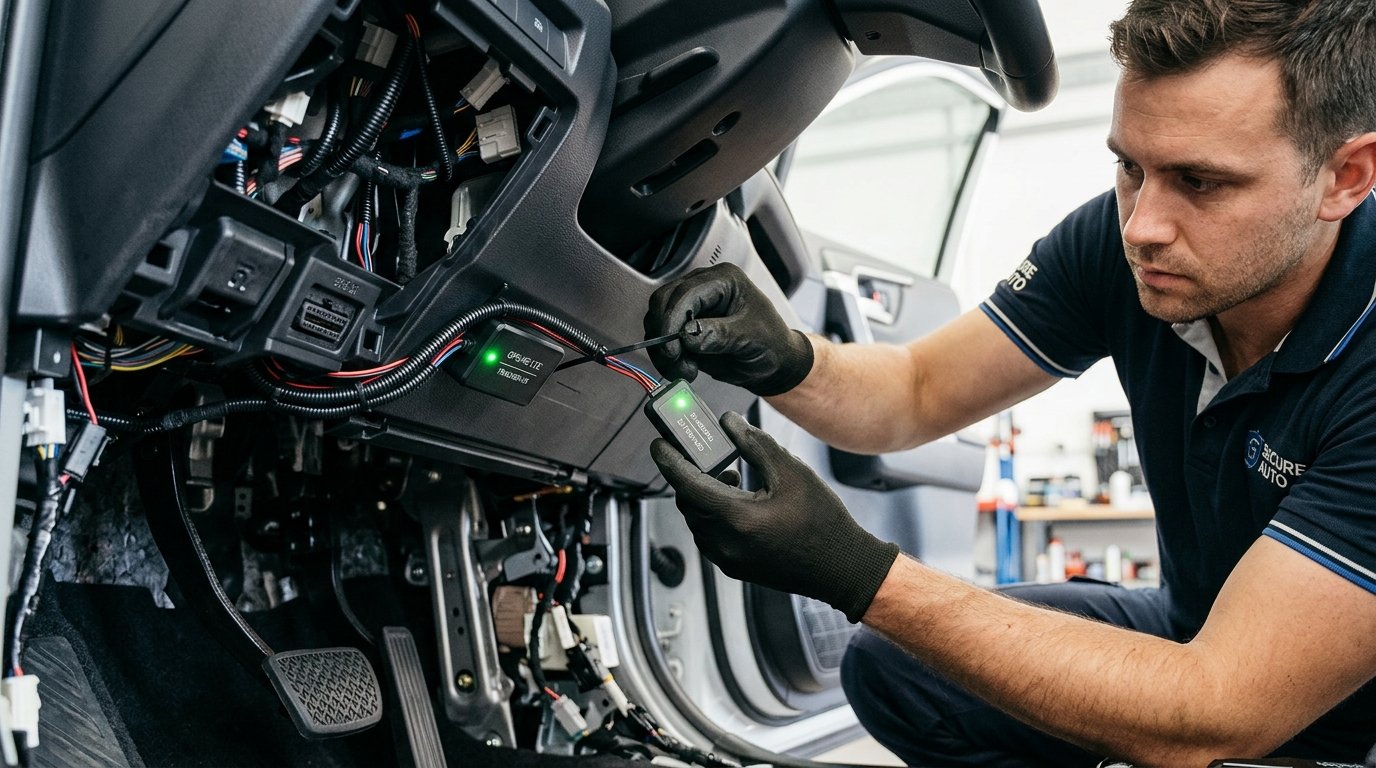
- Covert OBD2 Y-Splitter Harnesses: If you must use an OBD2 tracker, install a stealth OBD2 pass-through extension harness. You unclip the factory OBD2 connector from the dashboard metal bracket, plug the tracker into the hidden branch tucked deep behind the instrument cluster, and snap the dummy replacement OBD2 port into the factory dash opening. When a thief or technician glances under the dash, the factory port appears empty!
- Hardwired 3-Wire Trackers (The Professional Standard): The most resilient anti-theft trackers utilize a dedicated 3-wire harness: +12V Constant Power (Red), Chassis Ground (Black), and +12V Switched Ignition Sense (White/Yellow). Tucked high above the pedal box, behind the HVAC ducting, or inside the center console wiring loom, a hardwired tracker is virtually impossible for a thief to locate quickly during a high-stress vehicle heist.
3. Starter Kill Relay Wiring: The 30A Bosch SPDT Circuit
The ultimate theft deterrent is the ability to remotely disable your vehicle’s starter motor via smartphone app or SMS command, leaving the vehicle completely dead in its tracks:
- The Automotive SPDT Relay (Single Pole Double Throw): A standard 12V 30A/40A Bosch-style 5-pin automotive relay acts as a remote electrical switch. The relay features five terminals: Pin 30 (Common), Pin 87a (Normally Closed contact), Pin 87 (Normally Open contact), Pin 85 (Relay coil ground trigger), and Pin 86 (Relay coil +12V power).
- Severing the Starter Solenoid Wire: Under the steering column or at the vehicle ignition switch harness, locate the heavy starter crank wire (which only shows +12V when turning the mechanical key to the “Start” position, or when depressing the push-button start). Cut this wire completely in half.
- Wiring Terminals 30 and 87a (Failsafe Normally Closed): Connect the ignition switch side of the cut starter wire to Pin 30. Connect the starter motor solenoid side of the cut wire to Pin 87a (Normally Closed). Under normal conditions, the internal spring-loaded mechanical switch remains firmly closed, allowing full cranking current to flow seamlessly every time you turn the key.
- Wiring Coil Control Terminals 85 and 86: Connect Pin 86 to a +12V switched ignition source. Connect Pin 85 directly to the GPS tracker’s negative output wire (ground trigger). When you issue a “Stop Engine” command from your phone, the tracker pulls Pin 85 to ground, energizing the relay coil. The internal magnetic armature pulls away from Pin 87a, breaking the starter circuit and permanently preventing the engine from cranking over!

Figure 3: Electrical blueprint and circuit wiring schematic of an automotive 12V SPDT starter kill relay interlocked with a covert GPS tracking module.
4. Managing Parasitic Battery Drain: Sleep Modes & Accelerometers
Because anti-theft GPS trackers connect directly to the vehicle’s permanent +12V battery rail, poor hardware design can drain your car battery flat over a long weekend:
- Active Cellular Transmission Current Draw: In active transmission mode (updating GPS coordinates every 10 seconds), a 4G LTE tracker draws approximately 60mA to 120mA of current. If left in continuous active mode while parked, this current draw will drain a standard 50Ah car battery in less than two weeks.
- 3-Axis MEMS Accelerometer Deep Sleep: Quality trackers incorporate internal 3-axis MEMS motion sensors. When the vehicle has remained stationary for more than 5 minutes, the unit shuts off its high-power GPS satellite receiver and powers down its cellular modem into “Deep Sleep” mode, slashing current draw down to an imperceptible 2mA to 5mA.
- Instant Vibration Wake-Up: The microsecond the internal accelerometer detects physical vibrations (such as a door handle pulling, a glass break, a tow-truck hook engaging, or vehicle tilt), the tracker wakes up in under 500 milliseconds, powers on its 4G modem, and beams an immediate Vibration / Tamper Alert to your phone.
5. Geofencing Boundaries & Multi-GNSS Satellite Precision
Configuring your telematics software ensures you receive actionable alerts before the vehicle leaves your neighborhood:
- Polygon and Circular Geofences: In your tracking mobile application, establish virtual perimeter boundaries around your home, parking garage, and workplace. The moment the vehicle exits the boundary without your authorization, automated push notifications and SMS alerts dispatch instantly.
- Multi-Constellation Satellite Reception: Premium tracking units decode signals from multiple satellite constellations concurrently (US GPS, European Galileo, and Russian GLONASS). This multi-GNSS tracking ensures sub-meter location accuracy even when parked inside concrete parking decks or underneath dense urban skyscraper canopies.
6. Tamper Detection & Internal Battery Backup Architecture
One of the first actions seasoned vehicle thieves take upon gaining entry is popping the hood latch and severing the main 12V automotive battery terminal:
- The Critical Role of Internal Lithium Backups: Commercial-grade hardwired GPS trackers incorporate an internal rechargeable 450mAh to 1,000mAh lithium-polymer backup battery. The instant external 12V vehicle power drops to 0.00V, the tracker’s power management IC instantly switches to internal battery power in under 10 microseconds without rebooting.
- Instant “Main Power Cut” SMS Alarm: The microsecond main 12V power is severed, the tracker triggers an emergency priority transmission to telematics servers, dispatching an immediate “CRITICAL ALERT: External Battery Disconnected” push notification and automated phone call to your smartphone. The internal backup battery provides 24 to 48 hours of autonomous location beaconing, giving law enforcement a decisive window to track the stolen vehicle even if loaded into an enclosed metal transport trailer.
7. Tilt Sensors & Predatory Tow-Truck Detection
A significant portion of modern vehicle thefts do not involve driving the vehicle away; instead, thieves use predatory flatbed tow trucks or wheel-lift “repo” trucks to snatch high-value vehicles in under 60 seconds:
- Gyroscopic Vehicle Tilt Angle Monitoring: High-end GPS trackers feature 6-axis internal gyroscopes that continuously measure vehicle pitch and roll angles relative to gravity. When parked on a flat surface, the baseline angle is calibrated to zero. If the vehicle is jacked up to steal catalytic converters or tilted upward at a 3-degree or greater angle onto a tow-truck boom, the unit triggers an immediate Tilt / Towing Alarm before the vehicle even leaves the parking space.
8. Frequently Asked Questions (FAQ)
Can a starter kill relay shut off my car while driving on the highway?
No, provided it is wired correctly into the starter crank circuit (Pin 87a to starter solenoid). Once the engine is already running, the starter motor is completely disengaged, so interrupting the starter wire has zero effect on the fuel pump, spark ignition, or engine ECU. Professional fleet systems also incorporate speed-sensing logic that refuses to execute fuel cuts if vehicle speed exceeds 5 MPH.
Do GPS trackers work if thieves use illegal handheld GPS/GSM signal jammers?
Professional car thieves sometimes power 12V cigarette lighter RF jammers that flood GPS and cellular frequencies with white noise. However, advanced trackers incorporate jammer-detection algorithms: if radio jamming noise is detected for more than 10 seconds, the tracker immediately triggers an internal alarm horn output or locks the starter kill relay, immobilizing the vehicle permanently before the thief can drive away.
Top 5 Best Anti-Theft GPS Trackers Benchmarked
Review our comprehensive hands-on laboratory evaluation comparing real-time refresh rates, monthly subscription tiers, starter kill relay reliability, and battery backup longevity.
DriveGear Lab security wiring practices conform to SAE J1939 telematics standards and Thatcham Research automotive security hardware installation guidelines.




One Comment