How to Check, Maintain, and Adjust Tire Pressure: Complete Cold PSI & Blowout Prevention Guide
Authored by the DriveGear Lab Chassis & Dynamics Engineering Division. A masterclass guide on cold tire pressure calibration, temperature-pressure thermodynamics (the 1 PSI / 10°F rule), TPMS threshold diagnostics, hydroplaning resistance, and sidewall blowout prevention.
Your vehicle’s tires are the only physical components connecting two tons of accelerating steel, glass, and passenger cargo to the asphalt. At 65 MPH, each tire’s contact patch—the actual surface area touching the roadway—is scarcely larger than the sole of a running shoe. Maintaining correct tire pressure is not merely about preventing a glowing TPMS warning light on your dashboard; it directly dictates your vehicle’s emergency braking distance, hydroplaning threshold, fuel economy, and structural resistance to catastrophic high-speed sidewall blowouts.
Lab-Benchmarked Tire Care Gear & Inflators
Explore Our Tested & Benchmarked Tire Inflation Equipment
We benchmarked digital sensor calibration, CFM airflow output, and auto-shutoff accuracy under heavy load:
1. Door Jamb Placard vs. Tire Sidewall: The Critical Distinction
The most common and dangerous mistake drivers make is reading the PSI number molded onto the rubber tire sidewall.
- The Sidewall Number is the MAXIMUM COLD PRESSURE (e.g. 44 PSI or 51 PSI): This is the maximum structural safety rating the tire carcass can withstand before bead decoupling or burst failure. It is NOT the vehicle’s recommended driving pressure! Inflating your tires to the sidewall maximum causes harsh ride quality, accelerated center-tread baldness, reduced braking traction, and leaves zero headroom for thermal pressure expansion during high-speed summer driving.
- The Driver’s Door Jamb Placard is the ENGINEERED VEHICLE SPECIFICATION (e.g. 32 to 36 PSI): Governed by FMVSS 110, this federal yellow-and-white tire information sticker is engineered by vehicle chassis dynamics specialists. It calculates optimal tire contact patch compliance based on your vehicle’s specific curb weight, front-to-rear axle weight distribution, suspension kinematics, and emergency braking performance. Always inflate to the door jamb placard rating!
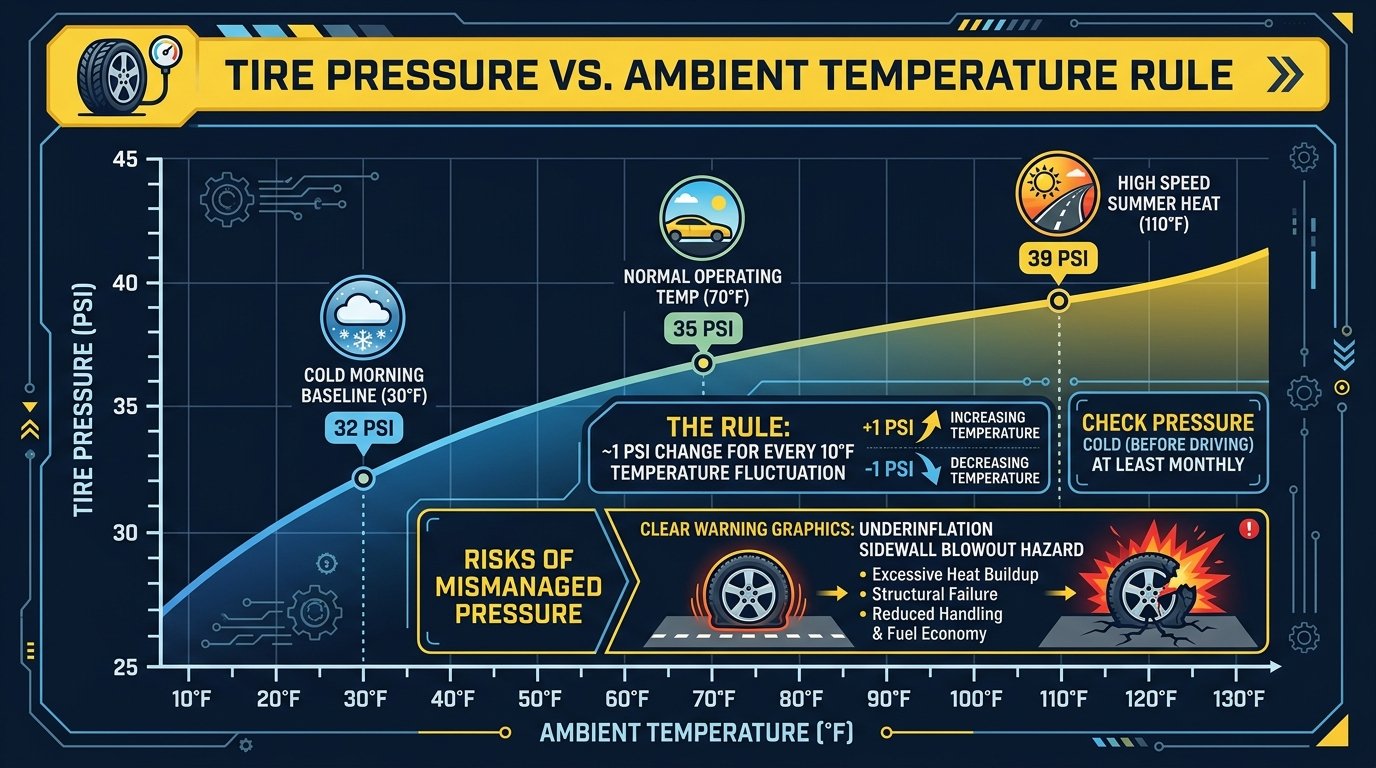
Figure 6.1: The 1 PSI per 10°F thermodynamic temperature fluctuation rule and high-speed sidewall blowout hazard physics.
2. The Thermodynamic Rule: 1 PSI per 10°F Temperature Change
Air behaves strictly according to the Ideal Gas Law (PV = nRT). As ambient air temperature shifts throughout the seasons, the air molecules sealed inside your tire carcass compress or expand:
- The 10°F Rule: For every 10° Fahrenheit (5.6° Celsius) drop in ambient temperature, tire pressure drops by approximately 1.0 PSI.
- The Autumn Cold Snap Phenomenon: If you set your tires to 35 PSI on a warm 80°F afternoon in August, a chilly 30°F morning in November represents a 50°F ambient drop. Without any air leak whatsoever, your tire pressure naturally drops by 5 PSI, dipping to 30 PSI and triggering the dashboard TPMS warning light!
- Driving Thermal Expansion: Normal highway driving flexes the tire casing, generating friction heat that naturally increases internal tire pressure by 3 to 5 PSI. This is why you must ALWAYS measure tire pressure when tires are completely “Cold” (parked for at least 3 hours or driven less than 1 mile at low speed). Never bleed air out of a hot tire!
3. The Deadly Physics of Underinflation Blowouts
Most drivers assume tire blowouts are caused by overinflation (a tire “popping like a balloon”). In reality, over 85% of catastrophic highway blowouts are caused by UNDERINFLATION!
When a tire is underinflated by just 6 to 8 PSI, the tire’s sidewalls can no longer support the weight of the vehicle upright. As the wheel rotates at 70 MPH (revolving roughly 800 times every minute), the rubber sidewall repeatedly flexes, buckles, and compresses against the road surface.
This violent mechanical flexing generates intense internal kinetic friction, driving internal carcass temperatures above 200°F (93°C). The extreme heat melts the internal rubber bonding vulcanization between the steel belts and nylon plies. Eventually, the tread carcass delaminates, disintegrating the sidewall in milliseconds into shredded debris—causing sudden vehicle instability and rollover crashes.
4. Hydroplaning & Wet Braking Dynamics
On wet or rain-soaked highways, the tire tread must pump water away from the contact patch through deep circumferential grooves. Underinflation severely degrades this water-evacuation capability:
- When underinflated, the center of the tire tread buckles slightly inward (“dishing”), leaving only the outer shoulders touching the asphalt.
- Water accumulates underneath the unsupported center tread, causing the tire to ride on a hydraulic film of water at much lower speeds—known as hydroplaning.
- Testing by tire engineers demonstrates that a tire underinflated by just 25% (e.g. 26 PSI instead of 35 PSI) increases emergency wet-braking stopping distances from 60 MPH by up to 30 additional feet—more than two full car lengths!
5. Decoding TPMS: Direct vs. Indirect Systems
Mandated on all passenger vehicles since 2008 under the TREAD Act, Tire Pressure Monitoring Systems (TPMS) alert drivers when tire pressure drops 25% or more below the placard target. Automakers employ two distinct technologies:
- Direct TPMS (dTPMS): Features a radio frequency sensor and lithium battery mounted to the back of each wheel valve stem. The sensor measures exact internal air pressure and temperature every few seconds, transmitting live telemetry to the vehicle ECU (e.g. Ford, GM, Toyota, Nissan). When the battery dies (typically after 7-10 years), the sensor must be replaced.
- Indirect TPMS (iTPMS): Does not use pressure sensors inside the wheels! Instead, the vehicle’s Anti-Lock Braking (ABS) computer monitors individual wheel speed sensors. Because a soft, underinflated tire has a smaller rolling diameter, it must rotate slightly faster than the other three wheels to travel the same distance. When the computer detects this speed differential, it illuminates the TPMS warning icon (common on Honda, Volkswagen, Audi, and Mazda).
- Why Indirect Systems Require Manual Calibration: After rotating tires, installing new tires, or adjusting tire pressures on an indirect system, you MUST perform a TPMS calibration reset via the dashboard infotainment menu. If you do not calibrate the system, the computer retains the old rolling radius values and will trigger false warnings!
6. Step-by-Step Tire Pressure Check & Inflation Protocol
- Check Cold: Ensure vehicle has been parked in shade or garage for at least 3 hours.
- Find Placard Value: Open driver door and locate the yellow-and-white tire placard on the B-pillar. Note front and rear PSI targets (some vehicles specify different pressures for front vs. rear axles).
- Use a Calibrated Digital Gauge: Avoid cheap metal “pencil-style” stick gauges with plastic slider bars; they are notoriously inaccurate by ±3 to 5 PSI. Use a calibrated backlit digital pressure gauge with a brass chuck.
- Unscrew Valve Stem Cap: Press the gauge chuck firmly and squarely onto the valve stem until the hissing sound stops. Read the display.
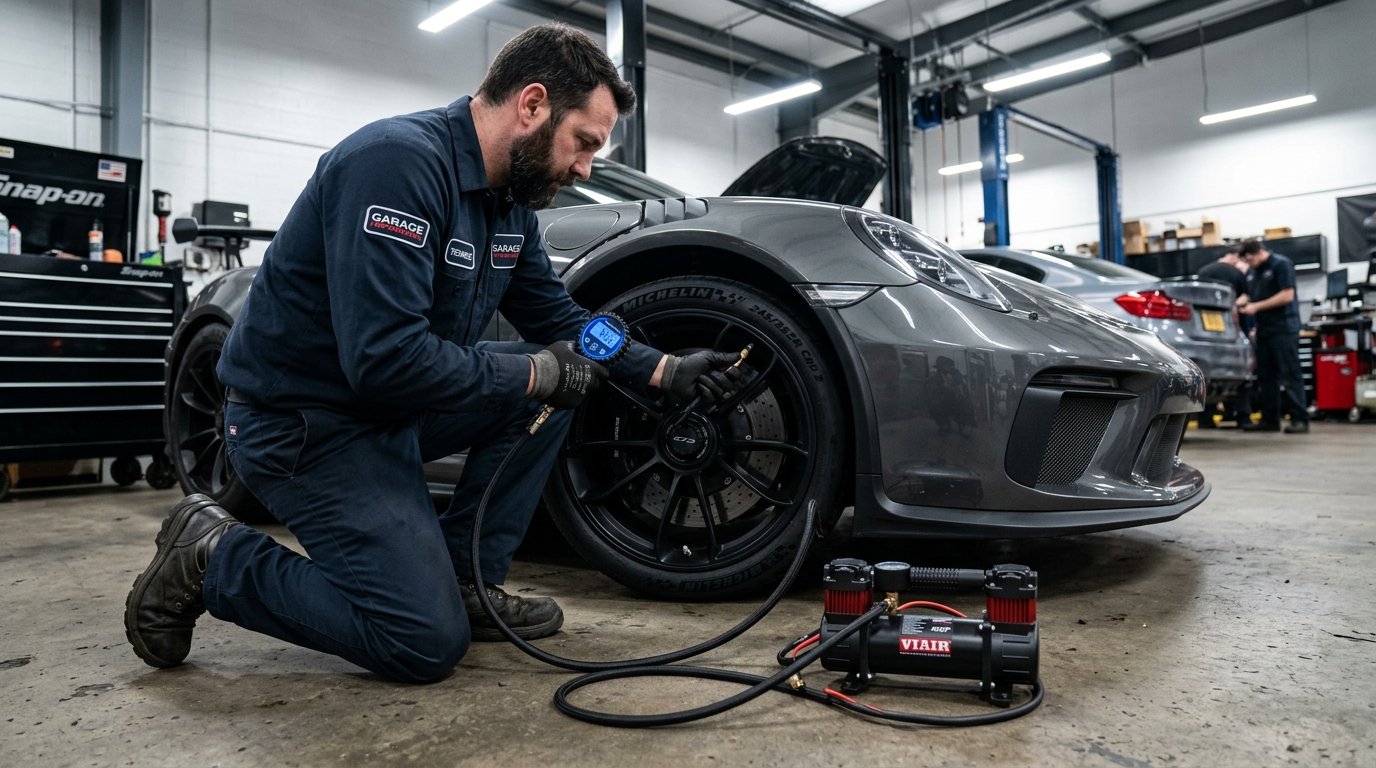
- Inflate with a Portable 12V Compressor: Connect a 12V portable tire inflator with automatic auto-shutoff preset to your door jamb target. The pump will inflate rapidly and shut off automatically at the exact target PSI.
- Inspect Valve Stem & Re-cap: Always re-install plastic or rubber-sealed valve caps. The cap’s primary engineering job is to keep road salt, sand, and water out of the delicate brass Schrader valve core. Never leave valve stems uncapped!
7. Nitrogen vs. Compressed Atmospheric Air: The Truth
Dealerships and tire shops frequently charge $40 to $80 for “Nitrogen Tire Inflation”, claiming nitrogen never leaks and doubles tire life. What is the engineering reality?
- Standard atmospheric air pumped from regular air compressors is already 78% nitrogen, 21% oxygen, and 1% trace gases.
- Nitrogen molecules (N2) are slightly larger than oxygen molecules (O2), reducing the natural rate of permeation through rubber pores by roughly 30%. A tire filled with standard air might lose 1 PSI every month, whereas high-purity (95%+) nitrogen might lose 1 PSI every 2 to 3 months.
- The Verdict: Nitrogen is beneficial for commercial aircraft and Formula 1 race cars where eliminating moisture prevents extreme internal pressure spikes under racing thermal loads. However, for everyday street driving, paying expensive dealership fees for nitrogen is unnecessary. Checking your tire pressure monthly with regular compressed air achieves 100% of the safety, tire life, and fuel economy benefits for free!
8. Frequently Asked Questions (FAQ)
Q1: How often should I check my car’s tire pressure?
Inspect tire pressure once every month, and always before embarking on long road trips. All tires naturally permeate approximately 1 PSI per month through the microscopic pores of the rubber compound.
Q2: What should I inflate my spare tire to?
Compact “donut” spare tires operate at a much higher pressure—typically 60 PSI. Because spare tires sit dormant in vehicle trunks for years, they lose pressure over time. Inspect your spare tire’s pressure every 6 months to ensure it is not flat when you experience an emergency.
Q3: Why is my TPMS warning light flashing when I start the engine?
If the TPMS indicator light flashes for 60 to 90 seconds upon starting the vehicle and then remains steady solid, it indicates a system malfunction rather than low tire pressure (e.g. a dead wheel sensor battery, wireless receiver fault, or unprogrammed sensor after tire replacement).
DriveGear Lab chassis safety protocols comply with DOT NHTSA standards, FMVSS 110/138, and Tire and Rim Association (TRA) engineering specifications.